
Gunadala and Auto Nagar
Include the institutional or ground owner's contact, delivery entrance and authorised working periods.
Boundaries for courts, turfs and shared grounds
Specify the perimeter around the game, with clear routes for players, visitors and maintenance.
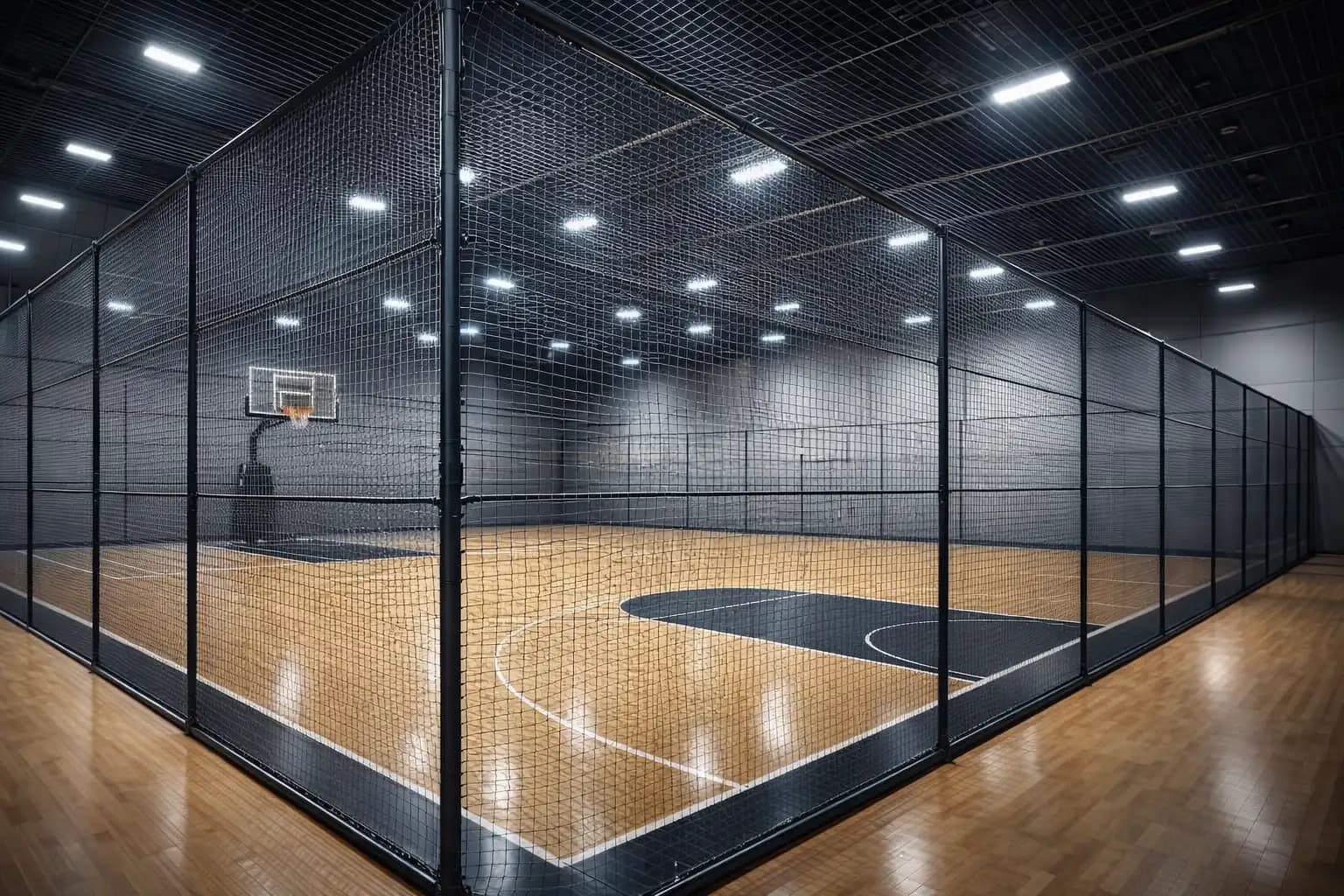
EverSafe installs sports nets in Vijayawada for the edges of courts, turf grounds and shared playing spaces. The work begins with the games played and the places a stray ball could reach, then the required boundary and access are measured. Standard net installation starts from ₹15 per sq ft, with new support structures and playing-surface work identified separately.
A brief for the entire playing space
This page addresses balls leaving a court or ground and interference between planned activities. Dedicated batting-and-bowling lanes are covered by the separate cricket practice service.
A court used mainly for football may also host small-ball drills or school activities. Include those uses in the brief. The operator should identify changes expected over time so the material is not chosen for one game and then relied on for another without review.
Goals, volleyball match nets and other equipment serve the game itself. The boundary serves a different purpose around the play area. Describe missing goal equipment, perimeter coverage and dividing panels separately so the estimate does not confuse their specifications.
Contain the intended ball
The gap in the net, its shape during use and the completeness of the perimeter affect containment. A larger ball being stopped does not establish how the same mesh behaves with a smaller one.
Ask for the mesh opening and twine description in the written specification. Do not substitute the diameter of the strand for the size of the aperture. The supplier should explain the selected option for the activities named in the brief.
When a football space gains cricket, tennis-ball or another smaller-ball activity, inspect both the panel and the remaining escape paths. A change of use can require a new mesh choice even if the old net appears undamaged. Discuss specialist games explicitly rather than relying on a multi-sport label.
Price, product and complete scope
The starting guide covers the agreed standard net coverage, compatible ordinary perimeter fittings and installation on suitable assessed supports. A panel schedule establishes the measured scope.
Work out a starting budget
Use the width and height of one net or grill face, rather than the balcony floor area. Add other faces to the final enquiry.
Installation is included in the starting scope. The selected product, complete coverage, access and any agreed additional work determine the final quote.
Posts, frames, foundations, structural or civil work, playing surfaces, drainage and lighting are separate. Confirm delivery, taxes, minimum billing and any visit charge in writing. Repair and refitting work has a separate assessment.
Make product comparisons useful
HDPE and nylon options can be considered alongside mesh construction, colour and the site's exposure. Comparison should be based on the complete supplied panel rather than a broad claim of stronger netting.
The choice needs to address regular contact and the way the net is attached. Knots or knotless joints, panel seams and perimeter reinforcement can affect maintenance. Request a clear description so a replacement section can later be assessed against the same intended use.
Edges at poles, gate returns and changes of level often deserve closer inspection than the middle of a panel. Abrasion at a rough contact point should be resolved in the fixing arrangement. Extra twine thickness alone cannot correct a damaging edge.
For an exposed Vijayawada site, identify the offered outdoor treatment and how components should be cared for. A sheltered indoor court has a different environment. Avoid treating a colour, polymer name or UV label as a promise of a fixed lifespan.
Look beyond the playing line
A boundary decision starts with the ball path and what lies outside it. This lets the proposal identify the useful sides without automatically enclosing more space than the brief requires.
Show roads, internal drives, windows, neighbouring plots and parking from the court edge. The shorter boundary may face the more sensitive interface. Mark any corner where a ball changes direction or a proposed panel would stop short.
Residents, pupils and staff should have practical routes that do not depend on walking through active play. Include access to seating, water, stores and the grounds-maintenance area. A perimeter that blocks those routes may be difficult to operate consistently.
Tell us where balls are actually leaving the space and when it happens. This is more useful than assigning a generic risk to a locality. For a new ground, the operator's planned games and surrounding layout provide the initial brief.
Plan the vertical coverage
Net height follows the intended game and surroundings, with a support arrangement suitable for the proposed coverage. There is no single height that suits every Vijayawada playing space.
A net along the perimeter may still leave a lifted-ball route above it. Where that matters, assess higher sides, overhead coverage or an alternative layout together with the support designer. The decision should be recorded as part of the agreed scope.
A mesh overhead panel is for the specified containment purpose; it does not keep out rain or provide the properties of a designed shade structure. Adding a tarp, advertisement or shade material later can change the support demands and needs its own review.
A boundary is more than the panel
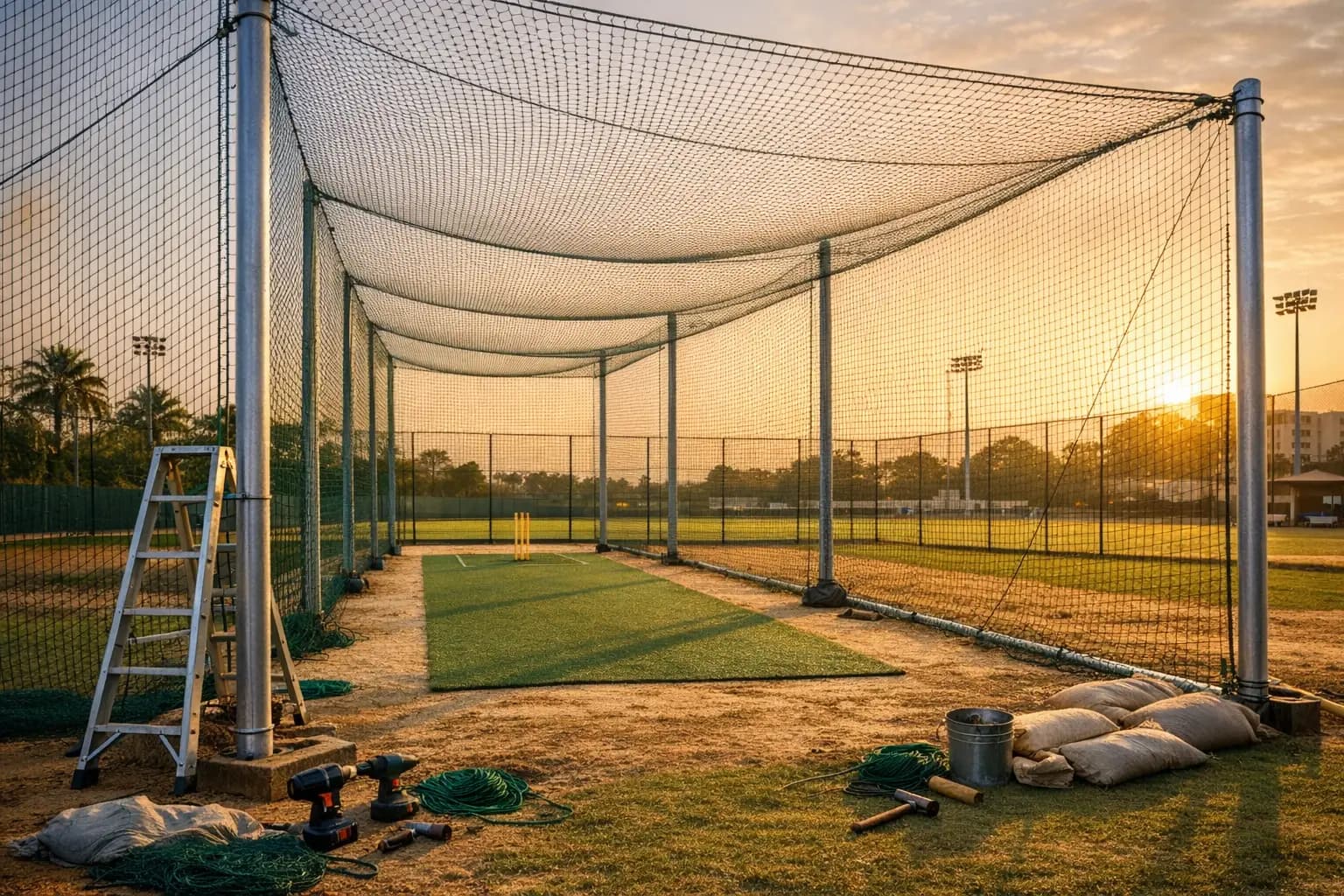
A long net run needs suitable attachments throughout its length. Existing posts, fencing and building edges are reviewed rather than assumed to be ready for a taller or different panel.
Send base, joint and corner photographs, particularly where rust or movement is visible. Review sharp edges and old fixes that have pulled free. Replacement netting should follow any necessary support work instead of hiding the defect behind a new panel.
Fabrication, foundations, structural checks and permissions are separate decisions from selecting the mesh. The proposal should identify who provides each part and when it is ready. Support dimensions and capacities should come from the appropriate assessment, not a generic net price list.
Make daily operation simple
A playing space changes between sessions. Balls, goals, cleaning equipment and people need a route that can be used without creating unmanaged gaps in the boundary.
Locate gates and opening panels where their operation is compatible with the games. Decide who controls them and how the boundary is restored afterwards. An improvised lifted corner may be convenient for entry but leave a persistent escape route.
Allow for the equipment used to maintain turf or a hard court, and identify how a damaged panel can be reached later. A new support should not obstruct drains or routine service access. These details are easier to resolve before panel lengths are finalised.
The enclosure should have a clear intended route instead of inviting people to squeeze through a join. Explain any special opening in the handover and keep its attachments as specified. Changes to the opening after installation should be reviewed with the rest of the boundary.
Local property questions
The postcode helps arrange the visit, but ownership, access and operating hours shape how the work can proceed. Give those details with the initial enquiry.
Identify the authorised contact, pupil movement and the periods when the work area can be kept separate. Include assembly or other uses of the ground in the brief. Netting for a sports boundary should not unintentionally close a route used for a different institutional activity.
The association or owner should approve the activity, support locations and delivery route. Show internal parking and walkways, and explain how maintenance staff reach nearby equipment. Independent approval avoids designing around access that later proves unavailable.
Coordinate net work with surface, drainage, frame and lighting contractors. A net quote does not include those jobs automatically. Where rain or direct sun affects the exposed site, describe the actual conditions and maintenance plan rather than assuming a standard enclosure will solve them.
An itemised boundary quote
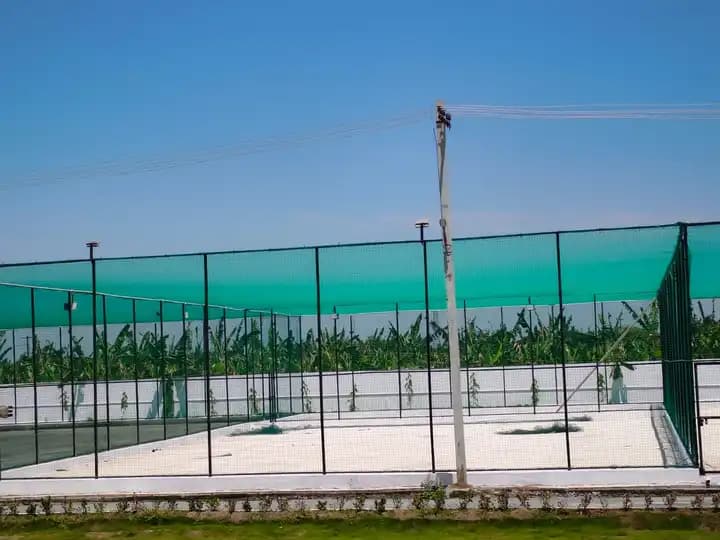
The installed panel area is separate from the court floor area. Corners, dividers and top coverage can add to the total, while openings and stepped sections need to be clearly shown.
Request each run's length, height and chosen material in the estimate. Mark where the boundary changes direction or level. This makes a partial repair, full replacement and new installation easier to compare without losing important coverage in the headline price.
At ₹15 per sq ft, 100 sq ft of the agreed standard net arrangement gives an illustrative ₹1,500. The final price follows the actual specification and site. Posts, foundations, turf, lighting, special access and other extras must be listed separately.
Choose by the job
Clear category choices help you obtain a quotation for the work you need rather than a generic bundle of sports products.
| Need | Relevant specification | Check separately |
|---|---|---|
| Balls escaping a court | Ball-stop perimeter matched to its games and surroundings. | Panel height, corners, lower edges and support. |
| Adjacent activities interfering | Divider arrangement suited to the balls and circulation. | Its role compared with the outside boundary. |
| Batting and bowling practice | Dedicated cricket lane and its training layout. | Run-up, back coverage, dividers and pitch. |
| Goal or match equipment | The appropriate playing net and its attachment system. | It is not a substitute for the ground perimeter. |
| Sun or rain shelter | A separately designed shelter or shade project. | Do not add coverings to sports-net supports without review. |
Keep the owner and contractors aligned
Installation is coordinated after scope, support readiness and access are confirmed. The handover should explain what was fitted and how the boundary is operated.
Send the exact address, games, outward-facing photographs and approximate dimensions. Include gates, existing posts and the sides causing concern. State whether the request is new work, replacement netting or a fault repair.
Review the panel schedule, material, opening details and support responsibilities. Agree removal and delivery arrangements, any additional access needs and authorised working periods. Keep each separate project item visible in the quotation.
Work is separated from active play and panels are installed using the chosen system's method. Review joins, lower gaps and contact edges through the full boundary. Resolve any change to the agreed supports or layout before opening the area for its planned use.
Retain the specification and opening instructions for the facility manager. Identify the areas to inspect and how replacement panels can be requested. Sports netting supports containment; operation and supervision of the playing area remain the owner's responsibility.
Maintain the boundary rather than chasing holes
We assess patches, border repairs, reattachment and refitting of old sports nets, including previous work by another provider. Each repair is priced from the actual fault and access.
Photograph the hole and the surrounding panel. A compatible patch can be considered where the remaining material is serviceable. If several parts are failing or mesh breaks easily, replacement may be more practical than repeated patches.
Look for a rough post, moving support or contact with equipment. Repairing the attachment without correcting that cause can leave the same failure cycle. Keep the affected playing zone out of use where containment or support remains compromised.
Check openings, panel joins and accessible supports before use and after severe weather or nearby work. Follow the supplied cleaning guidance. Do not allow climbing, stored equipment or added signs to place unplanned loads on the boundary.
Coordinate dismantling before painting, surface replacement or frame changes. Review reusable panels against the final dimensions, not merely their original size. Storage, new fittings, disposal and making good previous attachment points should be agreed in the service scope.
Vijayawada and nearby coverage
Send the exact site address and its operating contact. These local groups organise enquiries without assigning a sport, risk or demand level to a neighbourhood.
Include the institutional or ground owner's contact, delivery entrance and authorised working periods.
For shared-property enquiries, explain permissions, existing supports and the routes that must remain usable.
Show each boundary and any separately arranged frame, surface, drainage or lighting work.
Make an informed choice
The starting guide is ₹15 per sq ft with the agreed standard net installation included. The net specification, measured boundary area, support condition and access establish the final quote. New posts, fabricated frames, civil work, turf and lighting are separate scope items.
At the starting rate, 100 sq ft of agreed standard coverage gives an illustrative ₹1,500. That does not price an entire court or guarantee a site total. The quotation must identify the actual net faces, specification and any separately required supports, removal or access work.
Tell us about football, basketball, volleyball and any other regular or occasional games in the space. The smallest ball and the expected use affect mesh selection. Specialist activities need their own specification; a general sports-net description does not make one panel suitable for every projectile or game.
A goal net is playing equipment attached to the goal arrangement. Ball-stop netting is positioned around the wider playing space to address balls that leave it. If you need both, identify them separately so the proposed dimensions, attachments and supply are clear.
It may not. List the smaller balls before ordering a multi-sport boundary. Aperture and its behaviour in use need to suit them, as well as the twine and perimeter. Have the existing installation reviewed before introducing a game with a different ball.
A partial installation is possible when the assessment supports that arrangement. The adjoining corners, gates and alternative escape paths still need consideration. The length of a boundary alone does not decide which section is most useful to cover.
Height follows the games, ball paths and conditions beyond the boundary. It must also work with a suitable support design. We review those factors with the operator instead of promising one standard height for every football turf, apartment court or school ground.
No. An overhead panel is a separately measured part of the agreed design. It may be considered where lifted balls can escape the space, but its supports and operation need assessment. A mesh roof does not turn an open court into a rainproof or shaded hall.
They can be reviewed for suitability and condition. The base, joints, sharp contact edges and intended attachments matter. An existing wall or fence should not be assumed to accept a taller net without the appropriate support assessment and permission.
No. The starting guide applies to the agreed standard net installation. New posts, foundations, structural supports, turf or hard-court surfaces, drainage, electrical work and lighting must be separately identified. A complete facility proposal should state which contractor is responsible for each part.
A divider can be assessed for the intended games and circulation. It needs suitable mesh, support and an agreed opening arrangement. Its role differs from an external boundary, so it should not automatically be treated as equivalent protection for people outside the ground.
Measure each run's length and installed height, then add separately specified returns, dividers and roof faces. Keep gates and changes of level visible in the sketch. The playing-surface area is a different quantity and should not be substituted for the net-panel total.
Share authorised work periods, gate access, delivery restrictions and the person who can approve the work area. The schedule can then be planned around the agreed scope. Active play and public movement need to be separated from installation work; no fixed completion time is assumed.
Yes. We assess local patches, border repairs, reattachment and replacement panels, including earlier work by another installer. Photos should show both the defect and its support. A patch is only appropriate where the remaining material and fixing arrangement are still suitable.
Refitting depends on the material condition, stored dimensions and the final supports. Agree removal before surface, painting or frame work begins. Label and store reusable sections appropriately, then review the completed opening before reuse. Changes to the frame or old fixing points are separate work items.
Include the exact address, games, photos of all relevant sides, approximate panel dimensions and support details. Auto Nagar, Gunadala, Kanuru, Enikepadu, Poranki and Ramavarappadu enquiries are covered. Identify the ground or association contact and how deliveries and working access will be arranged.
Let’s plan your installation
Send the site location, photographs, approximate net dimensions and support details. We will help define a clear installation or repair scope.