
Shared-building access
Explain common terrace permissions and exterior access around the reported opening.
Assess the observed entry before choosing a barrier
Show the observed approach, opening and supports so a suitable net, rigid barrier or change to access can be considered.
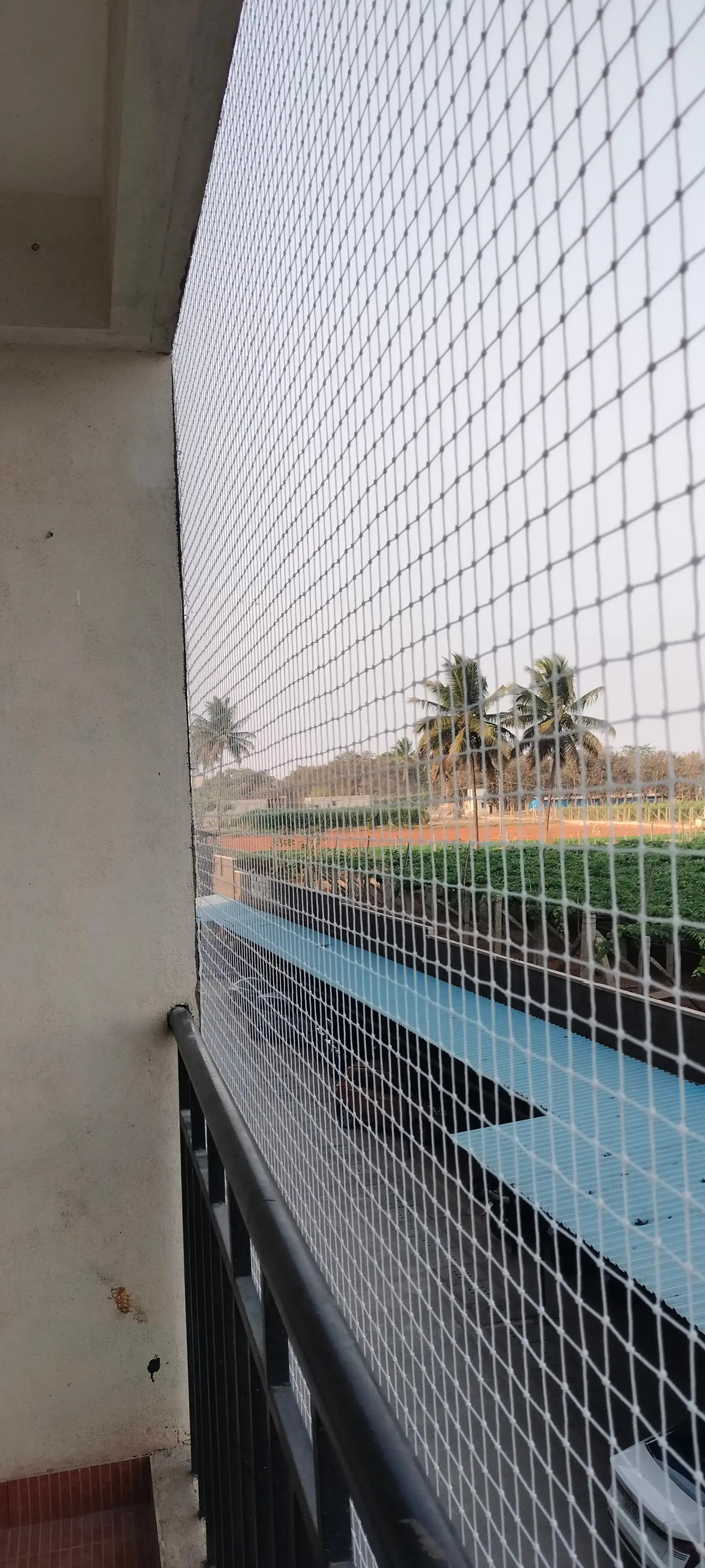
Make a practical plan for the opening a monkey has actually used. EverSafe assesses monkey safety nets in Eluru from ₹22 per sq ft including the selected net, fittings and installation where suitable, with rigid barrier options considered when the site needs them.
Start with what happened
Describe whether the animal passed nearby, reached an opening or repeatedly pulled at an existing barrier.
State whether the animal came from a roof edge, neighbouring structure or another observed approach, then identify the opening used. A tree near a home is not proof of that route. Photograph the setting from a safe indoor position.
Explain whether entry happened once or repeatedly, and whether an existing net was gripped, bitten or torn. A wide view plus a close image of any damage helps assess the weakness without asking you to approach an animal.
Compare workable barriers
Choose after reviewing the observed behaviour, support and closure. Thickness alone cannot establish a suitable arrangement.
| Site observation | Assessment direction | What needs checking |
|---|---|---|
| A defined opening with suitable support | Consider a specified net arrangement | All edges, reachable gaps and the observed behaviour. |
| Repeated pulling, biting or prior damage | Compare a rigid mesh or grille | Material, aperture, frame and secure fixing. |
| A door or window left open for daily use | Review a suitable closable barrier | Operation, latching and the user's access needs. |
| Several approaches to an open terrace | Review the full enclosure plan | Top and side routes, roof support and service entry. |
No option should be described as monkey-proof solely because of its material, strand thickness or product name.
Price, product and complete scope
From ₹22 per sq ft for the confirmed netting scope, including selected net, fittings and installation where suitable.
Work out a starting budget
Use the width and height of one net or grill face, rather than the balcony floor area. Add other faces to the final enquiry.
Installation is included in the starting scope. The selected product, complete coverage, access and any agreed additional work determine the final quote.
A rigid alternative has its own specification and quote. Repair and reattachment costs follow the assessed extent of work.
Ask for measurable details
Ask for a written specification of the net and edges, rather than relying on a heavy-duty label.
Ask for the supplied material, mesh opening and twine diameter in millimetres where specified. Available HDPE or nylon choices must be assessed for the purpose. A small mesh hole and a thick strand describe different characteristics, neither of which rates the assembly.
The border, connection method, intermediate support and wall or slab condition are part of the proposal. An animal may test an accessible edge rather than the middle. Explain any weak finish, previous fixing failure or movement in the existing support.
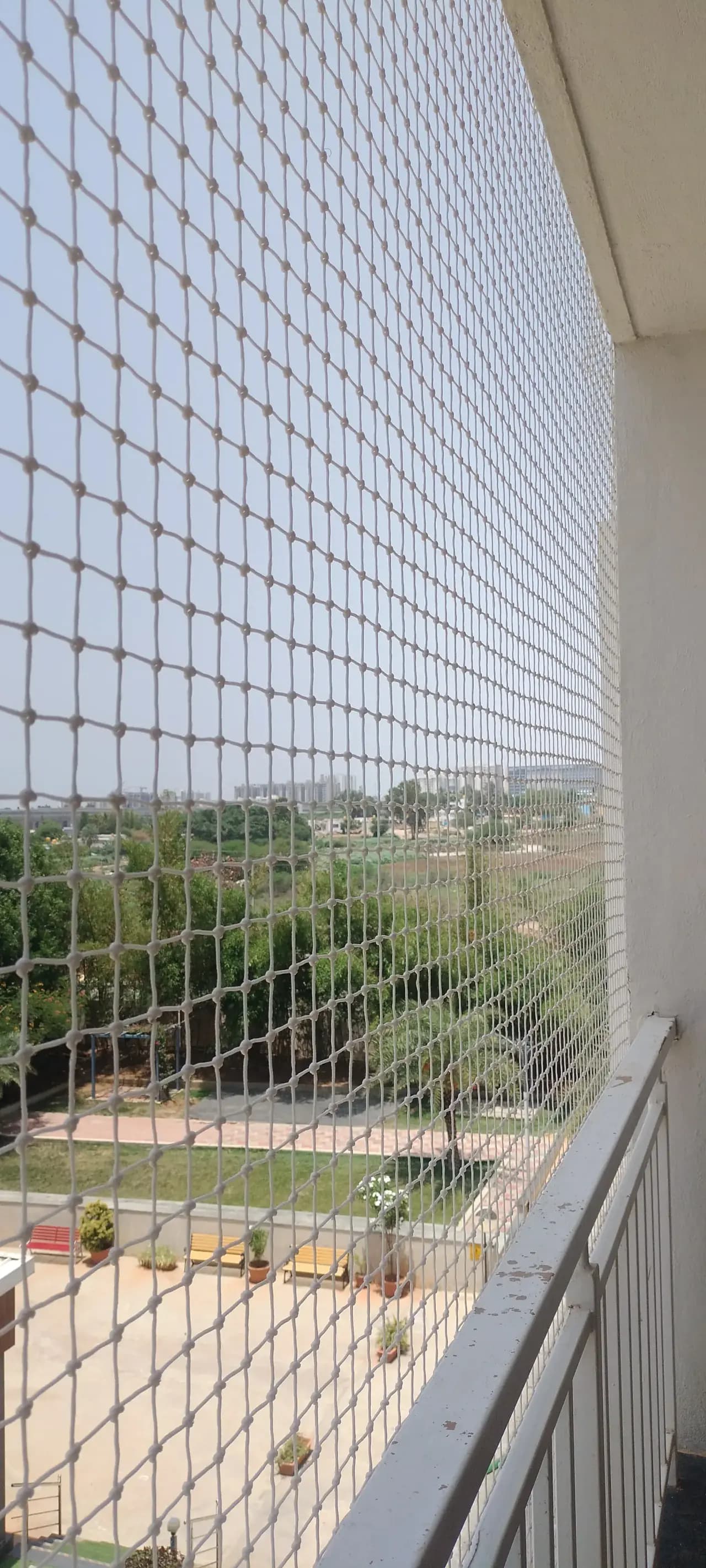
Measure the route into usable space
A strong-looking front face is incomplete if an accessible route remains around it. Show how the opening connects to the roof, neighbouring wall and lower boundary.
Measure each proposed face by width and height from a safe position. A 10 ft × 10 ft face is 100 sq ft; a side return is another face. Roof-level or overhead coverage needs its own dimensions and support assessment.
Show parapet steps, AC brackets, pipe openings and any roof access door. These details may require a different closure arrangement. Required access must remain usable, with the barrier design accounting for how it is opened and secured again.
Make the plan usable
A barrier has to suit the home's normal operation. Tell us how people use the space so the proposal does not depend on a panel being left open.
Demonstrate shutter travel, door movement and the route to roof services. If a panel must open frequently, consider whether a properly framed, closable arrangement would be more practical. The access detail is part of the barrier assessment.
Keep food and waste securely stored and avoid feeding monkeys. Explain food preparation or storage beside the opening so it can be considered alongside the observed route and proposed barrier.
Eluru enquiry examples
Include your locality, floor and a safe wide view of the reported opening so its supports and access can be reviewed.
For a flat or shared building, show the opening and describe whether the observed approach involves a common terrace or neighbouring structure. Identify who can authorise exterior access and any work affecting shared walls.
For an independent home, send a view that includes the roof line and the specific window, utility area or balcony involved. Note accessible side returns and whether roof maintenance would require opening the proposed barrier.
For a garden-facing or upper-floor opening, describe the approach actually observed and show existing supports. Include previous damage so repair and alternative barriers can be compared.
Assessment through handover
The quote should describe the proposed arrangement and when a different barrier needs consideration.
Review the reported behaviour, measurements, material information, edges and supports. Confirm access and whether animals are currently present. An occupied space must not be closed around wildlife; appropriate assistance may be needed first.
Complete agreed support or surface preparation and fit the selected arrangement when site conditions allow. Exterior work depends on appropriate access. Keep occupants and pets clear of the work area and retain the existing railing or guard.
Review the complete boundary, closures and access points together. Keep the material and scope details and know how to report changes. Handover confirms the agreed installation; it is not an animal challenge test.
Installed rate and example
The starting rate is ₹22 per sq ft including the selected net, fittings and installation where netting is suitable. A 100 sq ft example gives ₹2,200.
Ask for the panel dimensions, product description, edge arrangement and access method. Additional faces or supports can change the amount. If a rigid barrier is recommended, it needs its own specification and quote rather than the net rate being applied automatically.
A patch, reattachment or previous-work restoration is assessed according to the damage and access. There is no assumed repair minimum. The quote should explain whether the proposed work restores an existing arrangement or changes the barrier design.
Respond to the cause
Repair can be useful when damage is local and the remaining system is sound. The reason for failure determines whether repeating the old detail is sensible.
A section released for painting or damaged by maintenance may allow repair or reattachment after inspection. Send the whole panel and the affected edge, together with any information about the material and previous fixing.
Report new pulling, biting, opening of closures or repeated tears. Compare replacement and a different barrier if the current arrangement is unsuitable. Keep people and pets away from the affected opening until the issue has been assessed.
Useful first information
The best enquiry combines what happened with what can be installed at the property. It need not include a close photograph of the animal.
Provide your Eluru address, floor, opening dimensions and an account of the approach and contact. Mention any changes since the incident, such as a temporary covering.
Show the old net, grille or damaged fixing. Describe AC, roof and cleaning access so assessment, repair and alternative barriers can be discussed.
Eluru and nearby coverage
Send your exact address, observations and opening photographs for an assessment of the proposed barrier.
Explain common terrace permissions and exterior access around the reported opening.
Show the roof line, open returns and maintenance route together.
Send a safe wide view and describe what the animal actually did.
Make an informed choice
The starting installed rate is ₹22 per sq ft for the selected net and fittings where that arrangement is suitable. The final scope depends on the observed entry, covered faces, supports and access, with alternatives discussed when needed.
A 10 ft by 10 ft face measures 100 sq ft and gives a starting example of ₹2,200. Returns, overhead closure, support work and different barrier arrangements can change the final proposal.
A nearby sighting alone does not establish an entry route or the need for a net. Explain whether an animal approached, entered or damaged your opening. Photos of the route and property help decide what assessment is useful.
No blanket guarantee is appropriate. Suitability depends on the animal's behaviour and the complete assembly, including mesh, edges, fixings and supports. Persistent pulling, biting or repeated damage may call for a rigid barrier or another approach.
Not automatically. Increasing twine thickness does not establish resistance of the complete installation. A monkey-entry assessment must consider climbing, gripping, pulling, available openings and support condition rather than reusing a bird-net specification by name.
There is no universal mesh dimension we can promise for every site. Ask for the offered clear opening, twine diameter, material and edge design in the quotation. The assessment must relate that complete arrangement to the observed behaviour.
Discuss a rigid barrier when an animal repeatedly tests the opening, damages flexible material, or the proposed net cannot be adequately supported. Opening size, fixing design and closure hardware still require assessment; a metal label alone is insufficient.
A terrace requires review of the full route, including roof edges, access doors and any open top. A net across one side may leave another approach. Share overhead supports and service-access needs before expecting a simple area quote.
An easily manipulated closure may be unsuitable. Explain how often the panel must open and whether animals can reach its fasteners. The chosen barrier and closure need assessment together; an ordinary loose bird-net flap should not be assumed sufficient.
Keep food and food waste securely stored and avoid feeding monkeys. Review these housekeeping measures alongside the opening and the observed approach to your property when discussing a barrier plan.
Keep people and pets away from the animal and arrange appropriate local wildlife assistance. Do not corner it or close netting around it. Installation planning should continue only once the space can be assessed without trapping the animal.
A local defect can be assessed, but the cause matters. If damage came from repeated animal pulling or biting, restoring the same material may not solve it. Compare repair, replacement and a different barrier before proceeding.
Animal exclusion and fall protection are different purposes. Do not treat a flexible monkey-entry net as tested child fall protection. Retain suitable existing guards and explain any child-safety need for a separate assessment.
Share your Eluru address, observations, dimensions and access details. Enquiries cover Powerpet, Sanivarapupeta, RR Peta, Ameenapet, Satrampadu, Tangellamudi, Vatluru and Ashok Nagar.
Let’s plan your installation
Send the property location, safe photographs and any existing damage. We can discuss whether netting is suitable and compare repair or alternative barrier options.