
Central and frontage enquiries
For signs and ledges, mention working hours, access and nearby services.
A measured deterrent for the perch, not a full-opening cover
Good ledge treatment is a matter of fit: usable width, continuous coverage and a fixing method suited to the surface. Understand the linear price and product options before choosing pigeon spikes for your property.

Measure the ledge birds use, then choose a spike layout that covers that perch. EverSafe offers bird spike installation in Vijayawada from ₹120 per running foot including the selected strips, standard fixing and installation within the agreed scope.
Identify the perch
Photograph the whole ledge and its surroundings from a safe position. A bird-control strip should cover an identified landing surface rather than simply decorate a convenient edge.
Note the usable depth and where the birds stand relative to the wall. Include adjoining corners and higher surfaces. A strip on the front edge can leave space behind it if the perch is deeper than the product covers.
Describe whether birds go into an AC recess, roof pocket or balcony after landing. Spikes affect the suitable perch, not the full opening behind it. Netting can be assessed for that separate entry route.
If a previous strip moved the birds to an adjacent spot, show both surfaces. The next quote should reassess the landing options. Adding a short run without examining the rest of the perch may leave the practical problem unchanged.
Length, depth and spread
Linear pricing does not remove the need to measure depth. The chosen strip’s spread and the shape of the ledge determine the layout.
| Dimension | Record it this way | What it informs |
|---|---|---|
| Ledge length | List each separate run | The longitudinal coverage required. |
| Ledge depth | Measure the full usable landing surface | Whether the product covers one row or needs several. |
| Effective strip spread | Confirm the product’s stated coverage | A base width alone may not describe pin coverage. |
| Corners and fixtures | Photograph the spaces on each side | How short runs or layout changes meet at interruptions. |
| Access height | State the floor and reachable work position | Whether the standard work scope is suitable. |
Price, product and complete scope
Selected strips, standard fixing and installation are included within the quoted ledge treatment. Confirm the linear measurement basis and row coverage.
Work out a starting budget
Measure the total installed strip length across all required rows. A wide ledge may need more than one row.
Installation is included in the starting scope. The selected product, complete coverage, access and any agreed additional work determine the final quote.
Ask for minimum billing, tax treatment and written product/workmanship terms. A spike strip discourages perching on a suitable surface; it does not provide fall protection or close a whole opening.
Know the supplied product
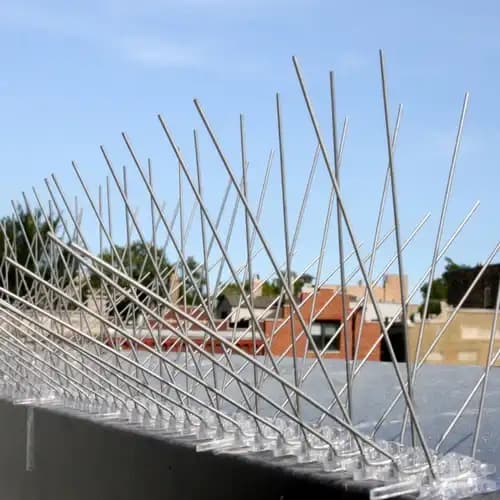
A clear base with metal pins is different from an all-polymer strip. The quote should identify the product arrangement before appearance or price is compared.
Confirm the pin material and the outdoor specification of the base. Slender pins and a discreet base may suit some ledges, but the strip still needs the appropriate spread and mounting method. Product information should describe the supplied arrangement.
Ask for the material and finish of both base and pins. Their compatibility with the fixing and substrate matters. Avoid assuming that the word stainless establishes the grade of every component or a universal service life.
Available designs vary in spread and use. Compare the product’s outdoor suitability and fixing requirements rather than calling all clear strips invisible. The selected item should be identifiable in the quotation and handover record.
Interrupted and curved perches
Sign brackets, pipes and curved surfaces can interrupt an otherwise straight treatment. These should be considered before the strip quantity is ordered.
Identify the surfaces beside and above the main ledge. For a Patamata or Kanuru apartment enquiry, note whether the sill is accessible from the flat or needs association-controlled access. A corner may need a separate short run, while window movement and drainage must remain practical.
For a Benz Circle, Governorpet or Labbipet shop frontage, show the sign, wiring access and the actual perch together. State when the premises can provide access for work. A shaped support needs a compatible attachment, and the finished treatment should remain maintainable when a sign or AC unit is serviced.
A broad surface can be unsuitable for a simple front strip. Compare the rows, product coverage and maintenance implications with another treatment if needed. The proposal should explain what remains reachable to birds outside the treated area.
Choose the fixing for the substrate
The surface condition and selected strip determine how the base can be attached. A product needs more than a clean-looking location to remain properly fitted.
Point out painted metal, tile, stone, concrete or a waterproofed surface. Loose coatings and damaged finishes need attention before mounting. The installer should explain what the proposed attachment is fixed to.
A suitable adhesive may work on some prepared surfaces; others call for an appropriate mechanical method. The product and substrate instructions matter. Improvised glue or a random fastener should not be assumed compatible simply because it initially holds.
Confirm cleaning scope and when the fitting can be disturbed after installation. Weather or surface conditions may affect the appointment. Required preparation should be visible in the scope rather than hidden behind a promise of immediate use.
Around outdoor equipment
A bird may sit on a bracket while nesting behind the unit. Identify both activities and the actual perch before proposing an appliance-area treatment.
Show the top, brackets and surrounding recess. Respect the unit’s installation guidance, required clearances and normal airflow. Do not assume that drilling or adhesive on an appliance is an acceptable attachment.
Technicians need to open covers and reach pipework and controls. A ledge treatment must allow that work or have a suitable removal plan. Tell us about an upcoming AC service before scheduling fitting.
When pigeons go behind the equipment, a surrounding net closure may deserve a separate quotation. A strip on top only addresses the selected landing surface. Compare the completed access arrangement for either option.
Understand the quantity
The selected strips, standard fixing and installation are included for the agreed treatment. A clear quote connects its linear quantity to the rows actually being fitted.
Ten running feet at the starting rate gives an example base amount of ₹1,200. Confirm what those feet measure and the covered width. This example is not the cost of every 10-foot ledge regardless of rows, preparation or product.
Two rows along a ledge use more strip than one row over the same length. Ask whether the quoted quantity is the surface length or the combined strip length. This avoids comparing different coverage as though it were the same job.
Removal of old strips, substantial surface preparation, repair and exceptional access may be separate where needed. Minimum billing and tax treatment should be stated. A retail packet price without installation is a different scope from a fitted treatment.
Placement for a used building
The decision includes how residents, staff and technicians use the surface. A product intended for birds should not be placed casually on a handhold or an accessible play area.
Handrails, walkable parapets and sills reachable by children or pets may be unsuitable. Explain who uses the space and how. The assessment should include those interactions before agreeing a location.
Do not obstruct an escape route, maintenance foothold or water channel simply to continue a strip. A change in position or a different treatment may be more appropriate. The relevant property manager should understand the proposed placement.
Avoid improvised sharp materials. The purpose is to discourage perching, not to injure or trap animals. Product information and a suitable location are more useful than a blanket statement that every possible strip is harmless.
Check suitability for the birds
Spikes are not a universal answer to every bird problem. The observed bird and behaviour determine whether the strip is appropriate for the location.
Some birds may use spaces that remain within or beside a deterrent arrangement. Describe the actual species and activity before selecting it. If the requirement is to exclude entry, a suitable mesh can be a more relevant discussion.
Report eggs, chicks or occupied nesting material. The affected work may need to pause for appropriate local advice or assistance. Do not force a strip into an occupied space or close an adjoining route while a bird is inside.
Debris or carried nesting material can change how a ledge is used. Arrange safe inspection when you notice it. A revised layout or different treatment may be needed if the original assumption about behaviour no longer fits.
Installation and handover
The work order should describe the selected surfaces and product, the fixing requirements and the access needed to complete it.
Send your Vijayawada locality, floor level and photographs with approximate length and depth. Include existing strips, nearby AC units and any nesting activity. Do not reach out to measure an unsafe surface.
Agree product, rows, run lengths and fixing method. Identify permissions, curing requirements and additional preparation. The installed quote should explain any work beyond standard fitting.
Complete the selected preparation and attachment process, then review corners and interruptions. Check that equipment, drainage and authorised access remain practical. Work around occupied wildlife requires the appropriate prior response.
Review the treated lengths and any temporary restrictions on touching or servicing them. Obtain the actual support terms and a contact for repair. Retain enough information to identify the strip if another section is needed later.
Previous strips and loose bases
We can assess earlier spike work for removal, reattachment or replacement. Reuse depends on the strip, base and the surface left after preparation.
The strip may be reusable if it remains intact and an appropriate new attachment can be made. Confirm the old adhesive or fastener condition. The repair scope should include whatever preparation the selected system requires.
If the underlying finish is failing, another layer of adhesive may not resolve the cause. Broken strips or incomplete row coverage can require replacement or a changed arrangement. Compare the proposed remedy rather than only the length being refitted.
Coordinate the treatment with the building work so loose strips are not left as an obstruction. Check what can be reused and when the prepared surface is ready for reinstallation. Agree responsibility for restoring the final coverage.

Keep the choice effective
A fitted strip remains a treatment for its specified perch. Changes to the surface or bird behaviour should prompt a useful review instead of automatic expansion.
| What changes | What to check | Possible next step |
|---|---|---|
| A strip loosens | Base, fixing and surface condition | Repair or refit the affected treatment. |
| Birds sit beside the strips | Actual usable width and adjacent perches | Review the row layout and work boundary. |
| Birds enter behind the ledge | The opening around a recess or balcony | Discuss measured pigeon-net exclusion. |
| Several smaller birds use service gaps | Target species and connected routes | Discuss an anti-bird mesh specification. |
| The surface becomes a regular handhold | Everyday use and reach | Reconsider the placement rather than leave an unsuitable treatment. |
Vijayawada and nearby coverage
Find your area and show the perch you want treated. A wide ledge view, approximate dimensions and access information help define an appropriate quotation.
For signs and ledges, mention working hours, access and nearby services.
Show the full sill depth and any AC or window access requirements.
Include floor level, old strips and the bird behaviour you observed.
Make an informed choice
Bird-spike fitting starts from ₹120 per running foot with the selected strips, standard fixing and installation included. The quotation should state its measurement basis, treated ledge width and row arrangement, plus any additional preparation or access work.
At the starting rate, 10 running feet gives an example amount of ₹1,200 within the standard installed scope. Confirm whether those feet refer to ledge length or installed strip length. Extra rows, a different product or other work can change the amount.
In this quote context both describe linear length. Neither is a square-foot area measurement. What also matters is whether the measured length describes the ledge itself or the total strips used across all rows.
One may be wider, interrupted by fixtures or harder to reach. A broader perch can need several rows or a different coverage product. Surface condition and the compatible fixing method also affect the proposed scope.
Measure the usable depth and compare it with the selected strip’s effective coverage. Include the space next to the wall and around brackets. The layout follows the product guidance and bird behaviour; a single front row is not automatically enough.
Ask about the actual pin material, base construction, outdoor-use specification and mounting method. Some strips use metal pins in a polymer base; others use different arrangements. Material labels alone do not establish the appropriate product for your perch.
A product-compatible adhesive can be considered for an appropriate sound surface. The system’s preparation and curing requirements must be met. Some locations need a suitable mechanical attachment or another method; no-drilling should not be promised without inspecting the substrate.
Fixing needs to be planned for the actual material and finish. Explain waterproofed, tiled or sensitive surfaces and obtain any property permission before work. The quote should identify the method rather than assume drilling is acceptable everywhere.
First identify the surface used: the unit top, bracket or wall ledge. Any treatment must respect equipment instructions and servicing, drainage and airflow clearance. An opening behind the unit may require netting instead of treating only the perch.
Suitable ledges, sign projections and shaped surfaces can be assessed with their access and fixing requirements. Curved or narrow supports need an appropriate attachment detail. Show adjoining surfaces that may remain usable as perches.
They are not a universal treatment for every species or nesting situation. Smaller birds may use spaces around some strips, and occupied nests require an appropriate response before work. Discuss exclusion netting when the actual problem is entry or nesting in a larger recess.
The intended use of a suitable bird-control strip is to discourage landing. Product and placement should be chosen for that purpose rather than using improvised sharp objects. Avoid blanket harmlessness promises and assess locations accessible to people, pets or wildlife carefully.
A handhold or surface within ordinary reach of children and pets may be unsuitable. The assessment should consider how people use the location, including maintenance and required access. A less accessible exterior perch is a different placement question.
A perch strip does not enclose the balcony face or close a duct. If birds enter behind the ledge, a measured net can be a more relevant option. Separate treatments may be proposed for separate perches and entry openings.
Yes, existing strips can be assessed for reuse, surface preparation and an appropriate fixing. Identify why they lifted before refitting. Broken bases, unsuitable old attachments or a deteriorated finish may need replacement or other work.
The work duration depends on preparation, access, product availability and any fixing cure time. Keep the actual written product and workmanship terms. Arrange attention to loose strips, debris or new landing pockets, particularly after building or equipment maintenance.
Let’s plan your installation
Share your Vijayawada area, floor and safe photographs of the ledge. Add approximate length and depth, note nearby equipment and tell us if old strips need removal or refitting.