
Best fit
Where stadium netting is used
Cricket grounds and practice facilities, football stadiums, golf ranges and courses, baseball grounds, schools and academies, and rooftop or box-cricket turf arenas.
Main service page
Start with the gallery, then use the sections below to compare fit, material, pricing factors, and booking questions before you decide.
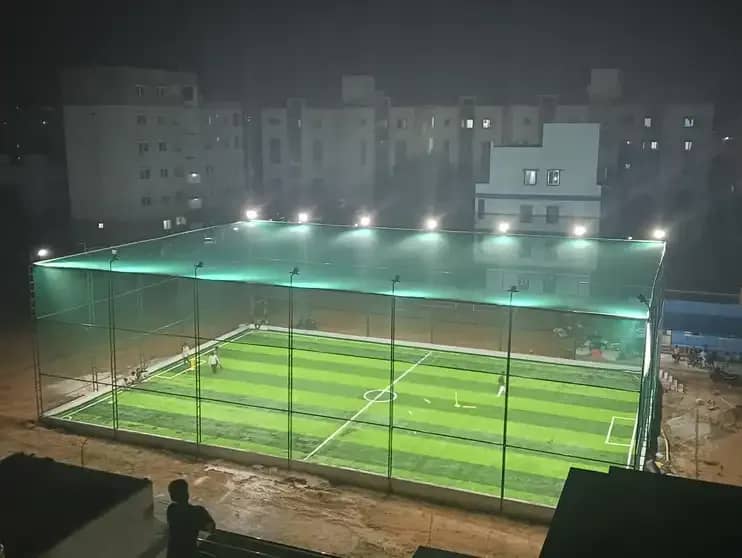
Quick decision view
A fast read on where sports netting fits, what shapes the estimate, and the details worth checking before you commission a system.
Why this helps
These are the four signals most people scan first before they decide whether to stay on this page, compare another service, or move straight to a quote.
Best fit
Cricket grounds and practice facilities, football stadiums, golf ranges and courses, baseball grounds, schools and academies, and rooftop or box-cricket turf arenas.
Main job
Keeping fast balls inside the field and protecting spectators, vehicles, and neighbouring property from impact.
Mesh & material
Mesh aperture matched to the ball, plus UV-stabilised HDPE or treated nylon in a knotted or knotless construction.
Structure
Steel masts, catenary cables, tensioning, and foundations engineered for the net's height and wind load.
Price factors
Netted area, height, mesh and material grade, and the structural scope of masts, cables, and foundations.
Upkeep
Periodic tension and cable checks, early repair of any tears, and net replacement at end of life.
Buyer guide
The cheapest per-square-foot net rarely gives the best outcome. A sound choice matches the sport and ball, the correct mesh and material, an engineered structure, the right height, and honest after-service.
Sport & ball
Golf, cricket, football, and baseball each need a different mesh aperture and net strength. The sport and the ball's speed drive almost every other decision.
Material grade
Ask whether it's UV-stabilised HDPE or treated nylon, knotted or knotless, and what twine thickness — those decide durability and impact resistance, not just price.
Mesh aperture
The mesh must be smaller than the ball. A net quoted without a stated aperture is a warning sign — it may let your specific ball through.
Structure & wind
For any tall net, the structure and foundation design for wind load matter as much as the net. Ask how the system handles a strong gust at full height.
Height & coverage
Height and coverage should come from where the ball goes and what sits behind the net — not a round number picked to keep the quote low.
Estimate scope
A useful quote separates netting, structure, foundations, installation, and after-service — so two estimates can be compared on equal terms.
Fast sports-netting shortlist checklist
A quick scan of these points usually tells people whether this page fits well, whether a nearby page may suit better, or whether it is time to request a quote.
Service highlights
Highlight 1
Stops fast balls leaving the field and protects spectators, parking, and neighbouring property from impact.
Highlight 2
Aperture sized to the ball — small mesh for golf, mid mesh for cricket and baseball, wider for football — so nothing slips through.
Highlight 3
Steel masts, catenary cables, and foundations designed for the load a tall net carries in a strong gust.
Highlight 4
UV-stabilised HDPE or treated high-tenacity nylon that resists sun, rain, and rot across seasons of outdoor use.
Stadium netting is a safety system with two connected jobs: containing fast-moving balls inside the field of play, and protecting the people, vehicles, and property behind the barrier from impact. It's used across cricket grounds, football stadiums, golf ranges, baseball diamonds, school and academy facilities, and the rooftop and box-cricket turf arenas that have grown quickly in recent years.
The defining technical decision is mesh aperture. Because the mesh has to be smaller than the ball, a golf net, a cricket net, and a football net are genuinely different products — the same netting cannot serve every sport. On top of that, the material grade, the net construction, and the height all have to suit the ball speed and the venue.
Just as important, and often underestimated, is the structure. A large net is essentially a sail, so the masts, catenary wire ropes, tensioning hardware, and foundations must be engineered for the wind load the net carries at full height. A perfect net on an under-designed structure is not a safe installation.
This page explains the two protective roles, the mesh sizes for each sport, the material and construction choices, the supporting structure and wind engineering, and what drives the estimate — covering both what you need to understand and what you need to commission the right system.
Most venues install sports netting to solve a concrete, repeating problem — balls leaving the ground, a crowd at risk, or a cheap net that failed too soon. These are the situations it's built for.
Why choose us
Benefit 1
Sport-specific mesh aperture and twine thickness, not a one-size net
Benefit 2
Wind-load engineered masts, wire ropes, and concrete foundations
Benefit 3
UV-stabilised, rot-proof netting suited to harsh outdoor conditions
Benefit 4
Custom heights and spans, including tall golf and cricket barriers
Benefit 5
Retractable and roll-up options where wind or seasons demand it
Benefit 6
Fire-retardant netting for indoor and covered arenas
Benefit 7
Turnkey delivery — site survey, fabrication, structure, and installation
Benefit 8
After-service re-tensioning, hole repair, and net replacement
Features
Sports netting fits any venue where a fast ball must be kept inside the field and away from people or property. The specification changes with the sport and the setting, but the core need — reliable containment and crowd safety — stays the same.
The best system depends on how the ground is used. A club cricket boundary, a school football field, a commercial golf range, and a rooftop turf arena each call for different mesh, height, and structure, which is why the same product is engineered differently for each.
Sports netting does two related but distinct things, and a good design is clear about which matters most for each part of the venue. Ball containment keeps the ball inside the field so play isn't interrupted and nothing outside gets hit — boundary nets, perimeter nets, and range barriers do this job.
Spectator protection focuses on catching the ball before it reaches people — backstop nets behind goals and home plate, and barrier nets in front of stands, dugouts, and walkways. The two often overlap, but the height, mesh, and exact coverage are planned around whichever role dominates in each zone.
The mesh aperture is the most important number on the whole quote, because it must be smaller than the ball to contain it. Get this wrong and the net fails at its one job. This is exactly why a single 'sports net' cannot serve every ground.
Golf demands the tightest mesh — commonly around 20–25 mm or smaller — because a golf ball is only about 43 mm across and travels fast. Cricket and baseball sit in the middle, typically around 40–50 mm, since those balls are roughly 71–75 mm. Football tolerates a wider mesh, often around 100 mm, because the ball is far larger. Whatever the sport, the aperture should be stated on the quote and chosen with a safe margin below the ball size.
Material grade decides how long the net lasts and how well it absorbs impact. HDPE (polyethylene) is UV-stabilised, rot-proof, and doesn't absorb water, so it stands up to sun and rain at a sensible cost — it's the default for most outdoor ball-stop and cricket netting. High-tenacity nylon has greater tensile strength and more stretch, so it absorbs impact energy better, which suits very high-impact or indoor use; its trade-off is water absorption and a need for UV treatment outdoors.
Construction matters as much as the fibre. Knotted netting ties every intersection for maximum strength and durability at the crossing points — the right choice for high-impact sports and tall outdoor barriers — while knotless (raschel) netting is lighter and more economical for lower-impact use. Twine thickness (ply) is then chosen for the ball speed and the life expected, and for indoor venues a fire-retardant grade can be specified.
A net is only as good as the structure behind it, and this is where cheap installations cut corners. A proper system uses galvanised steel masts, catenary wire ropes along the top and bottom (and sometimes the perimeter) to carry the net's load, turnbuckles to tension everything evenly, and concrete foundations sized for the mast height and wind load.
Even tension across the cables is what keeps the net flat, firm, and free of the sag and flap that wears netting out early. Mast spacing, cable diameter, and foundation depth are all engineering decisions that should come from the survey — not borrowed from a different ground of a different size.
Wind is the defining challenge for tall netting, because a large mesh span behaves like a sail. The mesh is partly wind-permeable, which reduces the load, but on any significant height the masts, cable tension, pole spacing, and foundations must all be designed for the wind the net will face — this is a structural calculation, not a guess.
For very exposed grounds, retractable and roll-up systems are a practical answer: the net can be lowered or gathered ahead of a storm or during the off-season, which protects both the structure and the net and extends its life by cutting constant sun and wind exposure.
Different sports lead to genuinely different builds. Cricket covers boundary and sightscreen-line barriers plus practice nets and multi-bay batting cages, which take repeated close-range impact and need tighter, high-durability mesh. Golf is the most demanding for height and containment, with tall mast-and-cable barriers and small-aperture mesh to hold fast drives on ranges and course boundaries.
Football and multi-sport grounds typically need ball-stop nets behind goals and along perimeters, while rooftop cricket, box cricket, and turf arenas need full enclosure — sides and usually a top net — engineered to contain the ball in a compact footprint while handling wind at height. Each of these is planned around its own ball, speed, and setting.
Indoor and covered venues bring an extra requirement: fire safety. Many arenas require netting to meet fire-retardant standards as part of their venue rules, and using a non-rated net can be a compliance problem as much as a safety one.
For these spaces we supply and install a fire-retardant grade specified for the venue, alongside the same care over mesh, tension, and fixing that an outdoor system gets. Indoor also tends to favour nylon for its impact absorption, since UV exposure is no longer the limiting factor.
Sports-netting price can't be judged on a single per-square-foot figure, because two big variables sit behind every quote: the netting itself, and the structure that holds it. A tall, wind-exposed barrier with deep foundations costs very differently from a low practice net, even at the same mesh.
A clear estimate separates the netting, the structure and foundations, the installation, and any after-service, and states the mesh and material grade. That breakdown is what lets you compare quotes fairly and see where a cheaper number is quietly leaving out structure or using lower-grade net.
We design and install sports netting for stadiums, club and community grounds, schools and academies, golf facilities, and the rooftop and box-cricket turf arenas that have become common on terraces and vacant plots. Each project is quoted from a survey rather than a catalogue, because ground size, height, and wind exposure vary so much.
The fastest route to a firm answer is to share your location, the sport, rough dimensions, and photos of the site. That lets us confirm feasibility, propose the right mesh and structure, and give a realistic timeline before any commitment.
Don't decide on price alone. A capable installer explains the mesh aperture, material grade, structure, wind design, and after-service before asking you to commit — and quotes from a site survey rather than a phone estimate for anything tall.
Photos help for a first look, but a firm proposal needs the sport, the dimensions, the ground conditions, and what sits behind the net. A survey protects you from a quote that leaves out foundations or under-sizes the structure and then changes on site.
A well-built net does its job quietly, but a little vigilance keeps it safe and long-lived. Inspect the net and cables after storms and heavy use, and don't ignore a small tear — a hole is exactly where a ball will find its way through, so early repair matters.
Keep the cables at proper tension, check turnbuckles and anchors periodically, and lower retractable systems ahead of severe weather. If the ground is re-graded, extended, or the structure is disturbed, have the system rechecked for tension and alignment.
Safety net installation process
A professional installation starts with a site survey and a structural design, because a sports net is an engineered system of mesh, cables, masts, and foundations — timelines below are indicative and larger grounds run as phased projects.
Step 1
The team assesses the ground, the sport and ball, the spans and heights, the spectator zones, and the wind exposure, so the system is designed for the real site rather than a standard layout.
Step 2
Mesh aperture, material grade, twine thickness, mast positions, cable runs, and foundation sizing are worked out together, with the structure engineered for the height and wind load.
Step 3
Net panels are cut, bordered, and joined to the exact dimensions, and the masts, wire ropes, tensioners, and fixings are prepared to the design.
Step 4
Foundations are set and cured, then the galvanised masts are erected and aligned to carry the catenary cables squarely.
Step 5
Top and bottom wire ropes are rigged, the netting is hung and secured along the cables, and turnbuckles are used to tension everything evenly for a flat, firm barrier.
Step 6
A final check confirms coverage, tension, and structural fixing, and the client is guided on inspection, retraction where fitted, repair, and future service.
Sports netting rewards light, regular attention. A quality UV-stabilised system shouldn't need much upkeep, but periodic checks of the net, cables, turnbuckles, and foundations keep everything tensioned and safe — and catch small problems before they grow into a failed net or a loose mast.
The two things that shorten a net's life are unrepaired damage and slack tension, both of which accelerate wear and let balls through. In exposed or coastal locations, pay extra attention to cable and hardware corrosion and to lowering retractable systems ahead of storms.
FAQs
The mesh aperture has to be smaller than the ball, so it's driven by the sport. Golf needs small mesh — commonly around 20–25 mm or tighter — because a golf ball is only about 43 mm across. Cricket and baseball use a mid mesh of roughly 40–50 mm, since those balls are around 71–75 mm. Football tolerates a wider mesh, often around 100 mm, because the ball is much larger. Tell us the sport and we'll match the aperture precisely — the wrong mesh is the single most common reason a net lets balls through.
Both are used, for different reasons. HDPE (polyethylene) is UV-stabilised, rot-proof, doesn't absorb water, and holds up well in sun and rain at a sensible cost — it's the workhorse for outdoor cricket, football, and ball-stop nets. Nylon (polyamide) has higher tensile strength and more stretch, so it absorbs impact energy better, which suits very high-impact or indoor use — but it absorbs water and needs UV treatment for long outdoor life. For most open grounds we lean to UV-stabilised HDPE; for High-quality impact absorption we specify treated nylon.
Knotted netting ties every intersection, which makes it stronger and more durable at the crossing points — the right call for high-impact sports, tall barriers, and long outdoor life. Knotless (raschel) netting is lighter and more economical and works well for lower-impact or shorter-term uses. We recommend based on the sport, the ball speed, and how long the net needs to last.
Height depends on the sport and where the net sits. Behind a football goal, systems commonly run 6–12 m; cricket boundary and sightscreen-line barriers often go higher; golf driving-range and course-boundary nets are the tallest, sometimes 15 m and beyond, because the ball travels fast and high. The right height comes from the ball's likely trajectory, the distance from the striking point, and what sits behind the net — we work that out at survey rather than guessing.
This is the core engineering question for any tall net, because a large mesh span acts like a sail. The mesh itself is partly wind-permeable, which helps, but the masts, cable tension, pole spacing, and foundations all have to be designed for the wind load at your site. For very exposed grounds we can specify retractable or roll-up systems so the net can be lowered ahead of a storm or off-season. Proper foundation and structure design is exactly why a site survey matters more than a phone quote.
Yes — spectator protection is one of its two main jobs. Backstop and barrier nets are installed behind goals, along boundaries, and over stands or dugouts to catch balls before they reach the crowd. The mesh, height, and coverage are planned around the seating position and the speed and direction of play, so the protected zone is covered rather than partly.
Yes. Practice nets and batting cages are a core part of what we install, from single lanes to multi-bay setups for clubs, schools, and academies. These use a tighter, high-durability mesh because they take repeated close-range impact, and the structure is designed so lanes can sit side by side safely.
Yes. Golf netting is among the most demanding work because of the ball speed and the height involved. We design tall mast-and-cable systems with small-aperture mesh to contain drives, whether for a driving range, a course boundary, or protecting an adjacent road or property.
Yes, and it's a fast-growing part of our work. Rooftop and box-cricket turf arenas need full enclosure — sides and often a top net — designed to contain the ball within a compact space while handling wind exposure on higher floors. We plan the structure around the roof or plot and the surrounding buildings.
A quality UV-stabilised net installed with the right tension and structure lasts for years of outdoor use; lifespan depends on the material grade, the climate, and how much direct impact and sun it takes. Cheap, non-stabilised netting is the false economy here — it goes brittle and frays far sooner. We'll set realistic expectations for your material and site.
Yes. Indoor and covered stadiums often require fire-retardant netting to meet venue safety rules, and we can supply and install a fire-retardant grade specified for the space.
Yes. Retractable and roll-up systems let you drop or gather the net ahead of high winds, off-season, or for events, which also extends the net's life by reducing constant sun and wind exposure. We'll advise whether a fixed or retractable system suits your ground.
There's no single rate, because the cost is driven by the total netted area, the height, the mesh and material grade, and — often the biggest factor — the structural scope of masts, cables, and foundations. A clear quote separates the netting from the structure and the installation so you can see what you're paying for, rather than one lump figure with no breakdown.
We deliver both. A net is only as good as what holds it up, so we design and install the masts, catenary wire ropes, tensioning hardware, and foundations together with the netting as one engineered system. If you already have a structure, we can assess it and supply netting to suit.
It varies widely with size. A single practice net can go up quickly, while a full stadium or golf barrier is a phased project — foundations need to be set and cured before masts and netting go up, so larger installations run across several days or more. We give a realistic timeline after the survey.
Yes — netting is fabricated to the ground. Panels are cut, bordered, and joined to fit the exact span, height, and corners of your site, including L-shaped, wrap-around, and enclosed layouts.
Yes. We repair tears and worn sections, re-tension slack cables, and replace nets that have reached the end of their life — often reusing the existing structure where it's still sound.
Related services
If this page is close but not exact, these are the next service pages worth comparing before you request a quote.
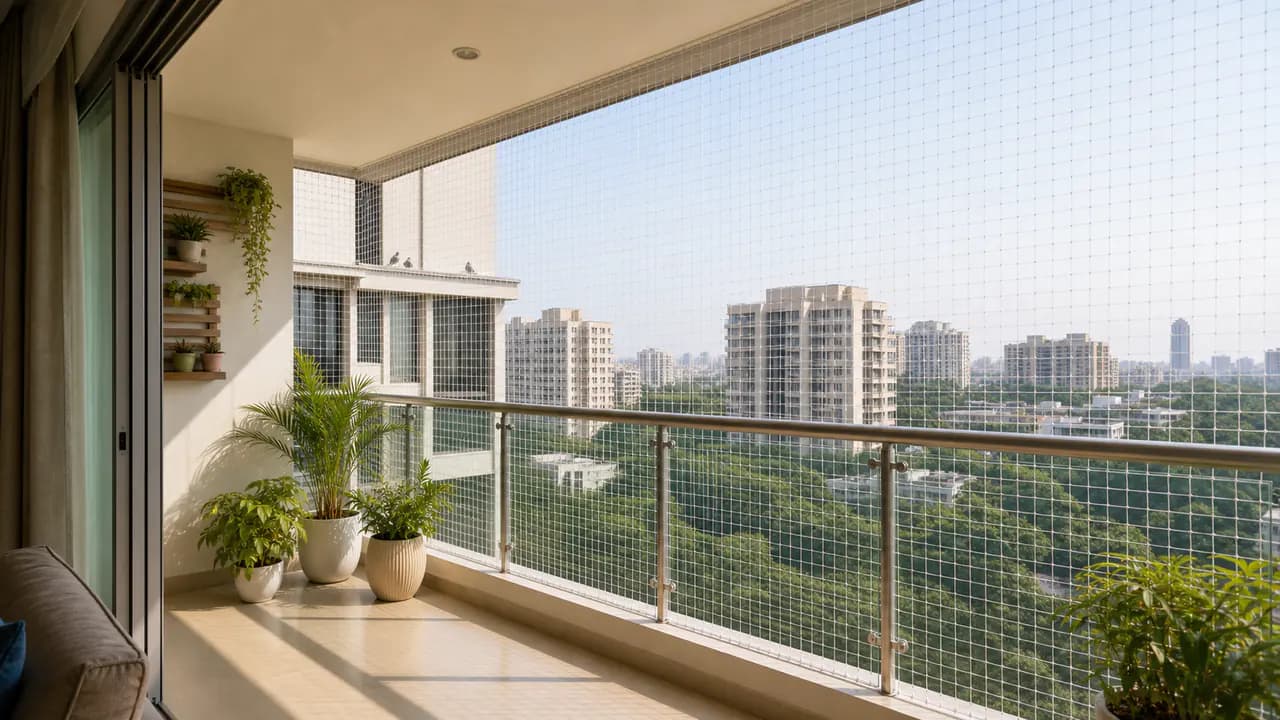
Main service page
Balcony Pigeon Nets help keep apartment balconies, ledges, AC corners, ducts, and utility ...
Explore →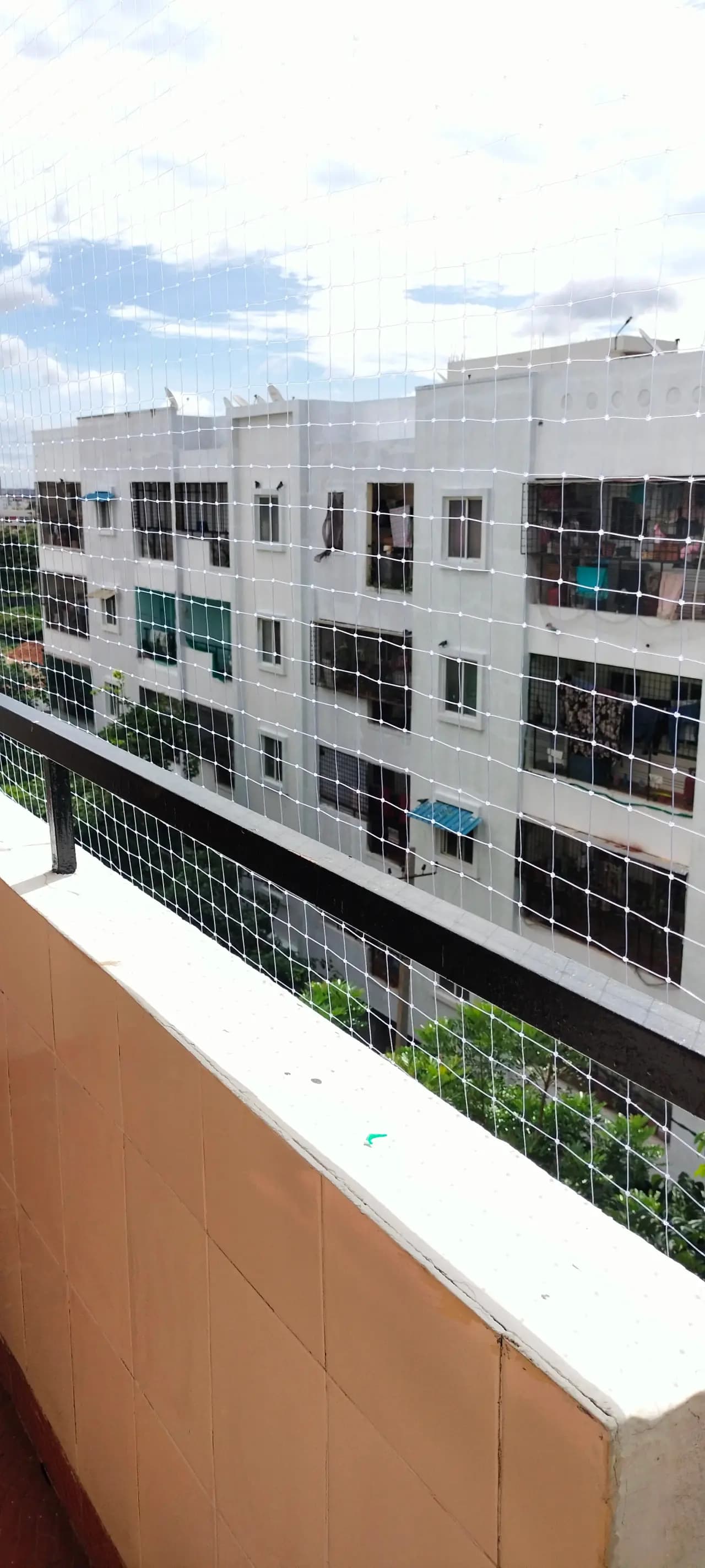
Main service page
Invisible Bird Nets are designed to protect balconies and windows without affecting your v...
Explore →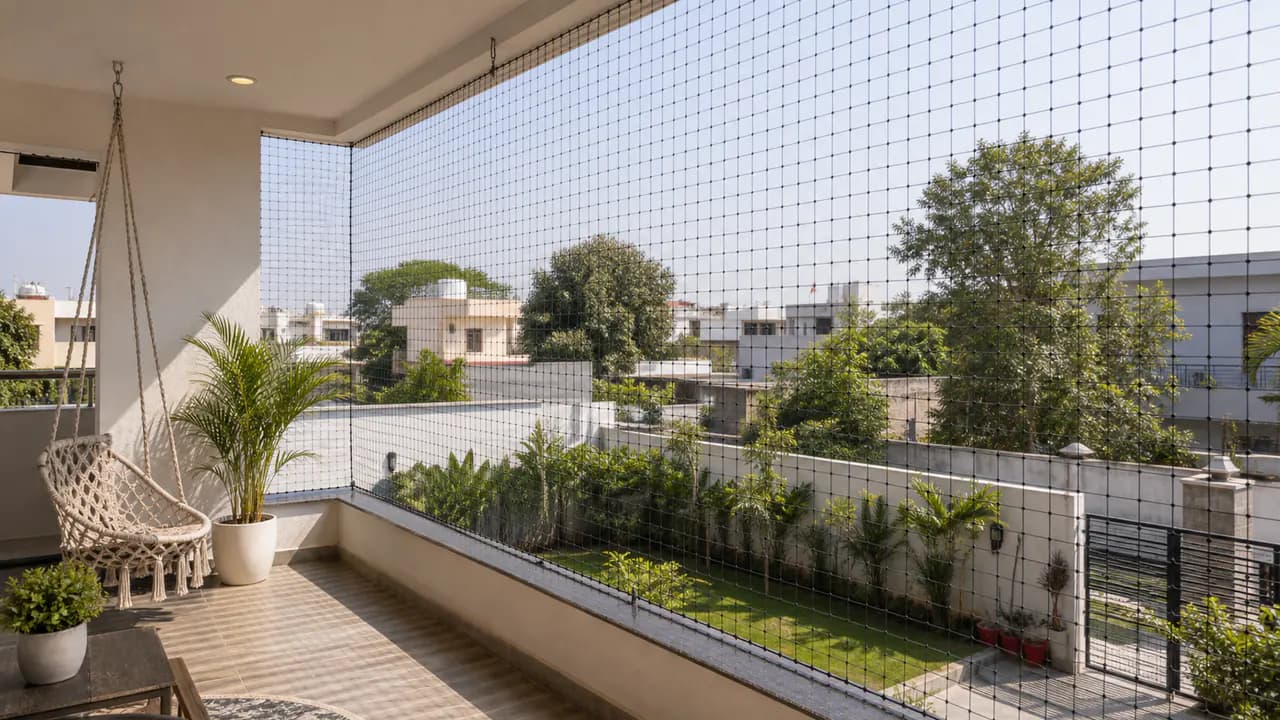
Main service page
HDPE Pigeon Nets are UV-stabilized high-density polyethylene mesh systems used for pigeon-...
Explore →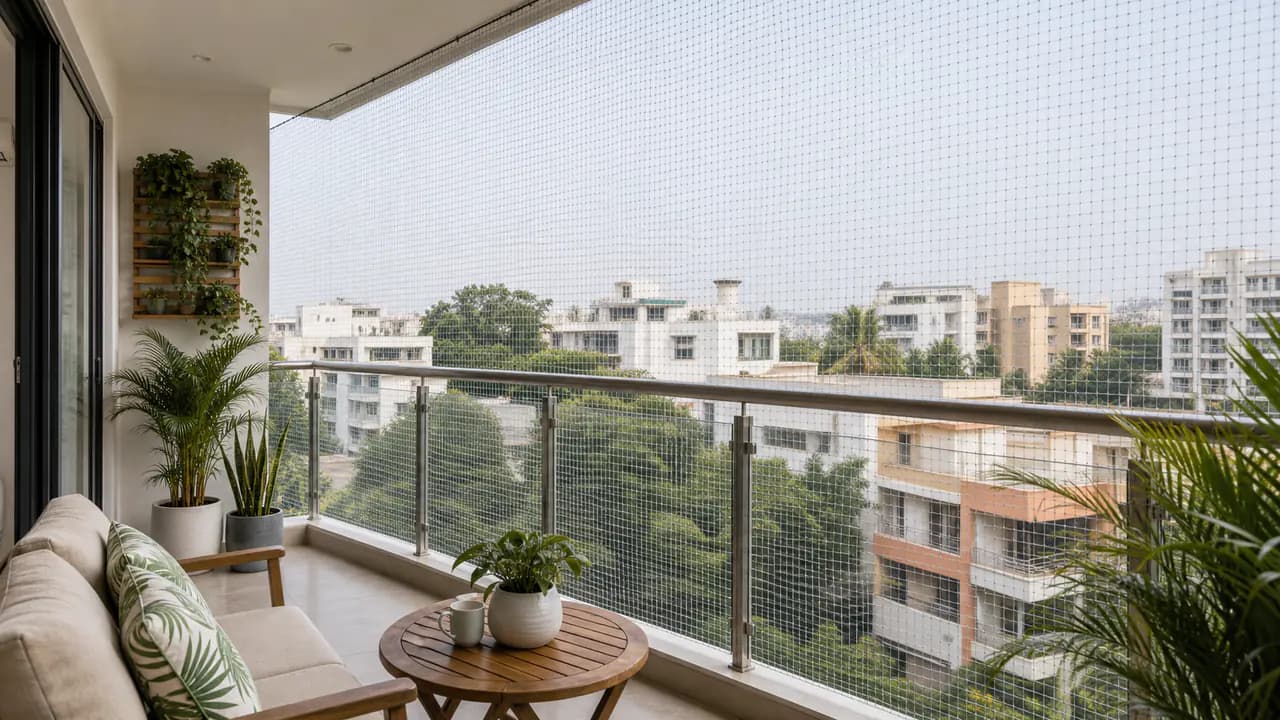
Main service page
Anti Bird Nets are custom-fitted mesh barriers for balconies, windows, ducts, shafts, terr...
Explore →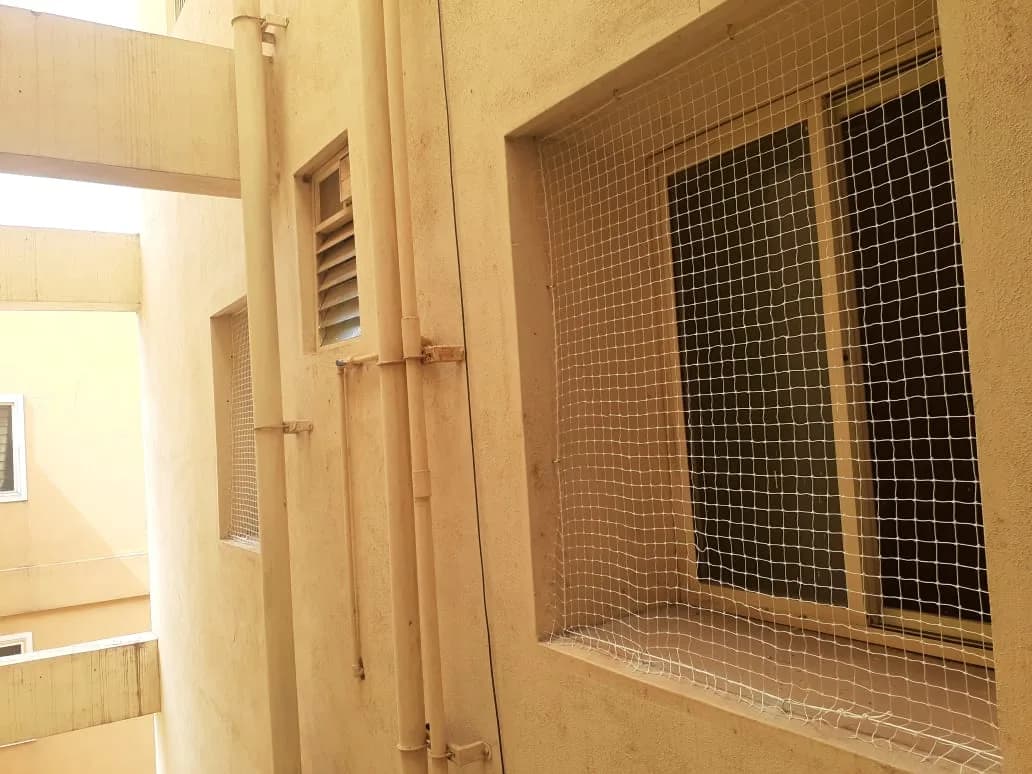
Main service page
Anti-Bird Nets for Windows prevent birds from entering your home while allowing fresh air ...
Explore →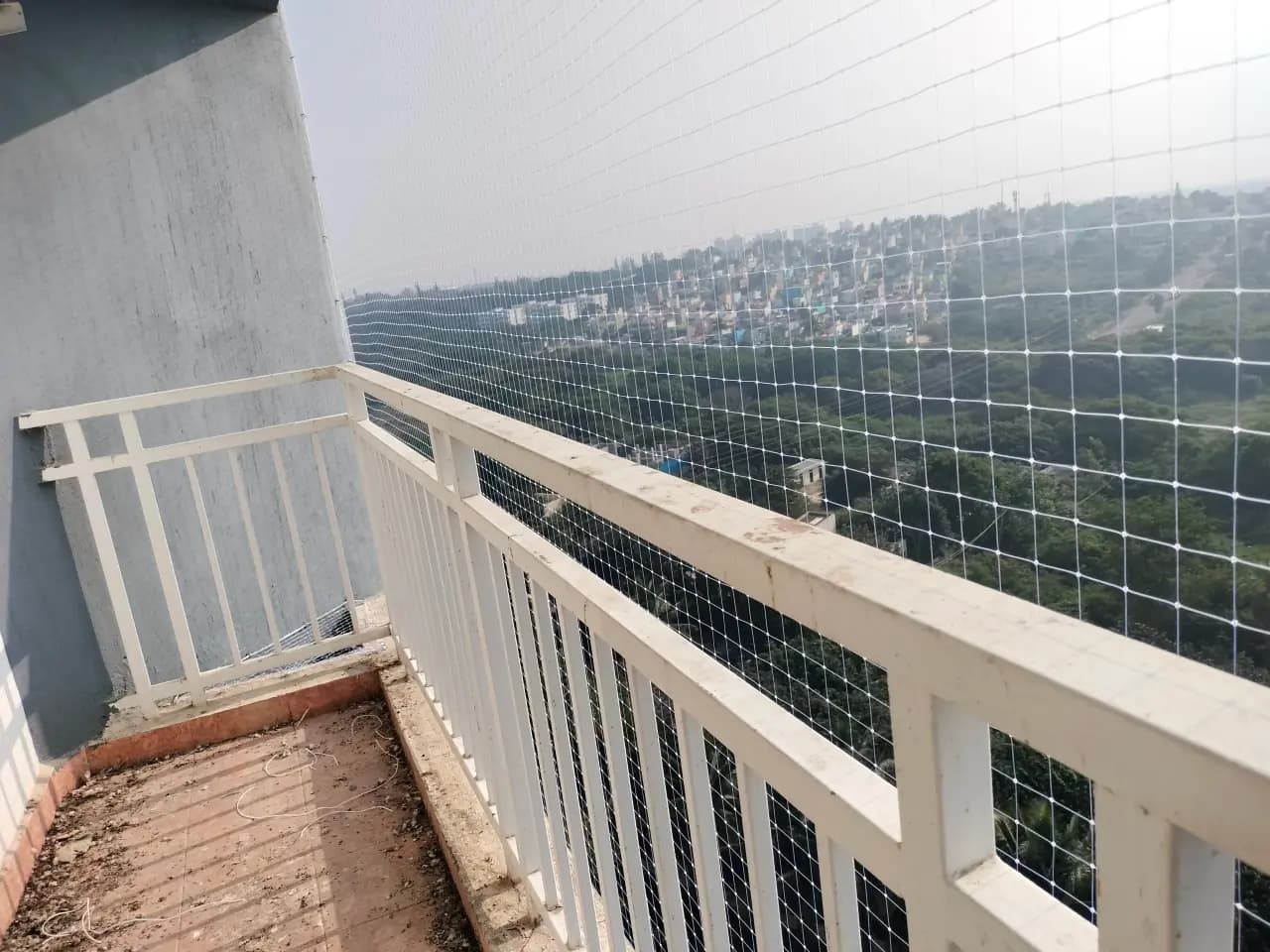
Main service page
Industrial Bird Nets are heavy-duty nets designed for factories, warehouses, production un...
Explore →Ready to compare or book
Get a clearer inspection brief, material guidance, and installation advice before you commit to stadium netting.
Share the opening size, photos, or site condition and we will help you judge the right next step quickly.