Assess the entry route before choosing the barrier
Monkey Safety Nets in Bangalore
Start with the entry route, then assess a suitable barrier for your home and the behaviour you have observed.
Plan a measured barrier for suitable balcony, window and utility openings where monkeys gain access. EverSafe monkey safety-net installation in Bangalore starts at ₹22 per sq ft, including installation. We assess the opening, supporting structure and animal behaviour before deciding whether a net is an appropriate option.
Which route are monkeys using to reach the opening?
A barrier works at a defined opening. It does not remove the reasons animals visit the property or guarantee that they will stop using nearby routes.
Record the route from a safe position
Tell us where monkeys approach, whether they enter the room and which edges they touch. Existing photographs or observations can help; do not approach an animal to obtain a closer image or stage a test against the proposed net.
Check connected building gaps
An open side beside the balcony, a utility window or a roof-level route may bypass the most obvious face. The measured scope should identify the opening to close and any connected gap outside that scope.
Reduce food access alongside the barrier
Accessible food, unsecured waste and deliberate feeding can encourage repeat visits. Keep food out of sight where practical and secure waste containers. A household and building-wide approach can be more useful than changing only one physical opening.
Match the building layout
Balconies, windows and rooftop service areas need different plans
The same mesh should not be stretched across every situation by default. Each layout has its own supports, access requirements and possible bypass routes.
Balcony fronts and side returns
A suitable closure may include the full front and connected sides, with careful attention to the lower edge. Existing railings and finishes must be assessed as part of the support arrangement. A large net centre does not compensate for a weak border.
Windows and utility openings
A small framed opening can be a better candidate for rigid mesh or a grille, particularly when the window needs frequent operation. Check the opening mechanism, supports and ability to secure any access panel after use.
Terraces and rooftop equipment
A rooftop garden, tank approach or utility area needs a defined enclosure scope and service access. Poles, frames or other support work may need separate assessment. Do not assume an existing roof fixture can support a new net simply because it is nearby.
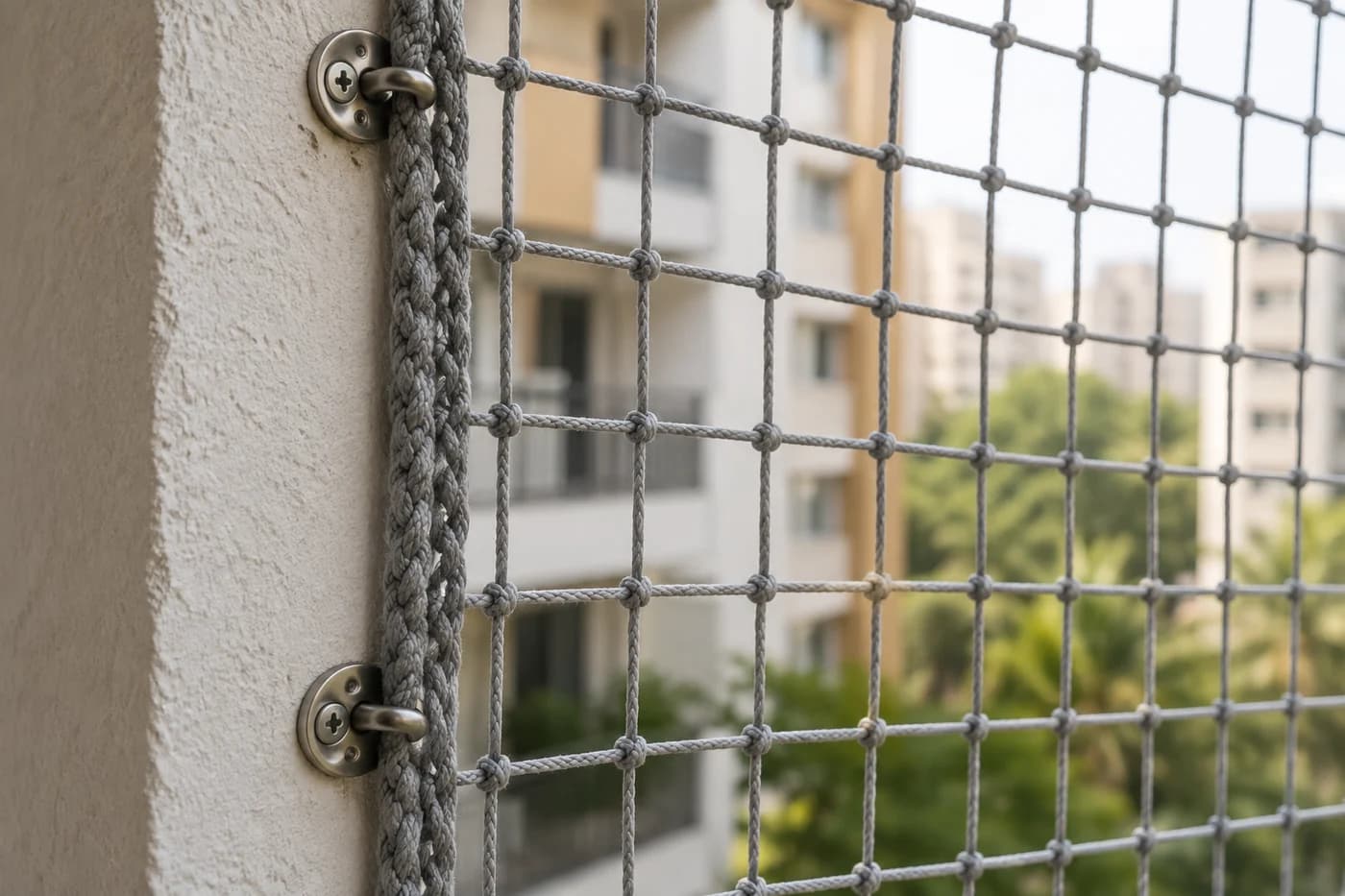
Installation illustration: the actual net, perimeter and supports need a site-specific assessment.
Price, with the scope explained
Monkey safety-net installation from ₹22 per sq ft
Installation is included in the starting rate for the agreed suitable netting scope. Product selection, measured panels and supporting details are confirmed through assessment. Each front, return and other agreed panel is measured separately; balcony or terrace floor area is not necessarily the net area.
Plan a starting budget
What could your installation start at?
Enter one netted or grilled face. Add side faces separately when discussing the full quote.
Enter your measurements to beginYour starting estimateStarting-rate illustration · Final scope and total confirmed in your quote.
Starting rate₹22/sq ft
What is included in the starting scope?
Selected netting for the agreed exclusion application
Fittings and installation within the written scope
Measured coverage and agreed perimeter details
What changes the final quote?
Observed animal entry and required product specification
Panel shape, support condition and additional framing needs
Access, permissions and removal or refitting work
Confirm minimum billing, taxes and any separate support work. If a net is unsuitable, a rigid barrier or specialist assessment should be considered rather than promising monkey-proof performance.
Assess the complete product
A thicker-looking net is not enough to prove suitability
Monkey safety net and anti-monkey net are service descriptions. The proposed product and installed system still need evidence relevant to the use.
A thicker-looking net is not enough to prove suitability
Specification
Useful question
What the answer should establish
Intended use
Is the supplied product suitable for this proposed animal-exclusion application?
A bird-control net should not simply be relabelled for monkeys.
Material and construction
What polymer, strand construction and product identification are supplied?
Nylon, HDPE, braided and heavy-duty labels alone are incomplete.
Mesh opening
How does the opening address access and entanglement concerns?
Choose a considered specification rather than the largest unobtrusive gap.
Border and connections
How is force transferred from the mesh to the supports?
The edge rope, attachments and building-side connections form one system.
Documentation
What relevant product evidence and written terms can be supplied?
No unsupported kilogram capacity, lifespan or monkey-proof promise.
Transparent mesh is not automatically appropriate for monkey entry. Appearance is considered after the proposed product and supporting system have been assessed.
The building side of the decision
Check anchors, perimeter support and possible loading
Animals can pull, climb or disturb a barrier. Suitability therefore depends on more than the net roll or the number of hooks visible in a photograph.
Assess the fixing surface
The installer needs to understand where the perimeter can be supported. Loose plaster, uncertain cladding, cracked finishes or corroded old attachments should not be treated as sound structural fixing points. Additional investigation may be needed before a design is agreed.
Consider the full span and its edges
Wide openings, corners and unsupported borders can change the support arrangement. The net, border, attachments and building form a connected system. Where the required suitability cannot be established, a different barrier or specialist structural assessment is the appropriate next step.
Do not improvise a strength test
A person pulling, hanging or jumping on a net does not certify the installation for animal behaviour or human safety. Rely on relevant product information and a considered installation assessment rather than demonstrations or an unverified load number.
Compare before committing
Netting, rigid mesh and grilles serve different openings
The most useful recommendation can be a different product. Appearance and price matter, but the opening, observed behaviour and maintainability come first.
Netting, rigid mesh and grilles serve different openings
Option
When to discuss it
Important consideration
Assessed flexible netting
A defined opening with suitable product and perimeter support
The complete system needs to suit the proposed exclusion use.
Rigid metal mesh in a suitable frame
Selected windows or service openings needing a rigid closure
Mesh, frame, hinges and anchorage require their own specification.
A properly designed grille
An opening where a rigid barrier and controlled access are preferred
Spacing and closure detail must suit the animal-entry requirement.
Invisible cable grill
A balcony where a cable system is being considered
Cable gaps and deflection must be assessed; the product name does not guarantee exclusion.
Routine bird netting
Pigeon or smaller-bird entry
It must not be assumed suitable for monkeys or human loads.
Beyond the net line
Trees, equipment and daily habits affect the access route
The netting scope should be clear about what it can address. Building management may need to handle related routes or maintenance that sit outside the fitting work.
Adjacent trees and structures
Nearby branches, parapets and connected roofs may remain part of the route even after one opening is closed. Any tree work or common-area alteration needs the appropriate owner or responsible professional. It is not included automatically in a netting quotation.
AC units, solar equipment and cables
Do not use an appliance, solar frame, pipe or electrical line as an improvised support. Required servicing and electrical clearances must remain workable. A rooftop or equipment-area request may need input from the responsible technician or designer.
Food storage and waste management
Coordinate with household members and the property team about food left outdoors and unsecured bins. A physical barrier is one part of reducing access. Avoid feeding, baiting or trying to train an animal to test the enclosure.
A building service, not wildlife capture
Keep the installation separate from handling an animal
The purpose is to assess and fit an appropriate barrier at an unoccupied opening. Capturing, relocating or confronting monkeys is not part of this installation service.
If a monkey is present
Keep people and pets at a distance and pause installation around the occupied route. Do not corner, chase or attempt to catch the animal. Contact an appropriate local wildlife professional or responsible authority for guidance where needed.
Before closing the opening
Confirm that an animal has not been enclosed inside the space and that the closure does not create a trapping arrangement. Any existing entanglement or wildlife concern must be addressed appropriately before ordinary fitting work continues.
After installation
Report visible damage, persistent attempts to enter or a new route around the barrier. Do not encourage an animal onto the net as a demonstration. If the installed approach is being repeatedly challenged, reassess the design and surrounding access conditions.
From assessment to handover
A site-led process for monkey-entry barriers
The work should make both the chosen solution and its limitations understandable. A site assessment may change the initial recommendation based on photographs.
01
Describe the observed route
Share the locality, floor level, opening photographs and what monkeys have actually been doing. Include connected side gaps and nearby equipment. This helps determine what needs inspection before any product choice is final.
02
Assess product, supports and alternatives
Review the proposed use, mesh specification, supporting structure and access requirements together. If suitability is uncertain, discuss a rigid alternative or specialist advice rather than assuming netting can resolve every opening.
03
Agree scope, permissions and access
Confirm the covered faces, quotation, property permission and any supporting work. Plan appliance servicing and required escape or building access. Work scheduling depends on these details and installer availability.
04
Fit and explain the maintenance plan
Complete the agreed installation and review the perimeter, controlled openings and visible checks. Record the supplied product and actual written terms. Handover should identify what to do if the barrier is disturbed or damaged.
Respond to damage early
Inspection, repair and replacement after the barrier is disturbed
A barrier exposed to animal contact needs attention to its current condition. Its original appearance is not evidence that it remains suitable indefinitely.
Look for changes from a safe position
Check for a sagging panel, torn strand, displaced edge, loose attachment or a changed access gap. Recheck after animal contact, painting or work on nearby equipment. Keep people away from a damaged opening until it has been assessed.
Decide whether repair is appropriate
A local repair is only useful when the surrounding mesh, supports and design remain suitable. Repeated damage may indicate the product or arrangement should be changed. Repairs and reattachment are quoted after the condition and cause are reviewed.
Reassess before reusing old material
An existing net, including another installer’s work, should not be transferred to a new opening without checking dimensions, condition and suitability. Product and workmanship support should be understood separately; no universal service life is assumed.
Your part of Bangalore
Discuss monkey-entry protection for your Bangalore property
Share your locality, photographs of the opening and the route you have observed monkeys using. The team can discuss access and whether a net or another barrier needs assessment.
South and southwest enquiries
Send the opening, observed route and whether the space is a window, balcony or roof area.
EverSafe starts at ₹22 per sq ft including installation for the agreed suitable netting scope. The final quote depends on the product, measured faces, supports and access. Frames, removal work, taxes or minimum billing must be clarified separately.
Are monkey safety nets guaranteed to be monkey-proof?
No universal monkey-proof guarantee is made. Behaviour, product suitability, supporting structure and ongoing condition all matter. The site assessment should establish whether netting is appropriate or a rigid barrier or specialist design is preferable.
Can a standard pigeon net be used to stop monkeys?
It should not be assumed suitable. A bird-exclusion net has a different intended use. The proposed product, mesh, border and full supporting system need assessment for the animal-entry requirement rather than being relabelled on the basis of thickness.
Which material is best for a monkey net?
Material names such as HDPE or nylon do not settle suitability. Ask for the actual product, construction, mesh opening and relevant supporting evidence. The perimeter and building-side fixing are part of the same decision.
Can transparent netting be used for monkey protection?
A clear appearance is not evidence of suitability. The actual product and complete installation must be assessed first. If the available transparent mesh is unsuitable for the opening and observed behaviour, a different barrier should be discussed.
Do you install monkey nets for windows and balconies?
Those openings can be assessed for a suitable barrier, including their connected sides and lower gaps. Small framed windows may be better served by rigid mesh or a grille. The recommendation follows the opening and support conditions.
Can you cover a terrace garden or rooftop service area?
A defined rooftop area can be discussed, but its enclosure, supports and maintenance access need separate planning. Tanks, solar equipment, pipes and electrical routes must remain accessible as required. Additional frames or specialist input may be necessary.
Are invisible grills suitable for keeping monkeys out?
A cable system is not automatically an animal-exclusion barrier. Cable spacing, deflection, opening detail and supports need assessment for the requirement. Compare an appropriately designed rigid grille or mesh where the cable arrangement is unsuitable.
Does a monkey net provide child or adult fall protection too?
Animal exclusion does not automatically establish suitability for human safety. State any separate child, pet or fall-protection requirement before the design is chosen. It needs its own assessment of the product and complete installation.
What should I do if a monkey is already inside?
Keep people and pets at a distance and avoid cornering, chasing or trying to catch the animal. Contact an appropriate local wildlife professional or responsible authority for guidance. Net fitting is not an emergency capture or relocation service.
Will netting stop monkeys visiting the building?
It addresses an agreed opening, not every route or reason for visiting. Food access, unsecured waste and feeding can encourage return visits. Coordinate those issues with the household or property team alongside the barrier assessment.
Can you repair an existing monkey net?
Existing work can be assessed for tears, loose edges and reattachment, including another installer’s net. Repair is appropriate only if the surrounding product, supports and design remain suitable. Repeated damage may require a different barrier rather than another patch.
A clear next step
Start with the opening and the observed route
Share your Bangalore locality, safe photographs, floor level and a description of the animal’s access. We can discuss a site assessment and appropriate barrier options.