
Residential and coastal locality enquiries
Mention whether people can reach the ledge and how windows or AC units are serviced.
- MVP Colony
- Beach Road
- Seethammadhara
- Siripuram
Measured perch treatment for ledges and sills
The right spike layout follows where a bird can land. Compare the usable ledge width, strip specification and mounting surface before choosing a pigeon-spike installation in Vizag.
Treat a narrow ledge where pigeons repeatedly land without covering an entire opening unnecessarily. EverSafe offers bird spike installation in Visakhapatnam from ₹120 per running foot including the selected strips, fittings and installation for the agreed scope.

Establish the behaviour
Bird spikes occupy a suitable perch. They are useful to discuss when the landing surface is the problem, but they do not enclose a balcony or service recess.
Show where pigeons actually stand, including the surface behind the front edge. A small parapet return or sign projection may need its own short run. The proposed treatment should match the bird’s landing space rather than a convenient visible line.
Birds entering beneath a roof detail, behind an AC unit or into a balcony may still reach the sheltered opening after a strip is added. A net closure is a separate discussion when the route itself needs enclosing.
Spikes are not a universal answer for every species or nesting situation. Explain what you have observed before buying strips. Active birds and nests need an appropriate approach before the surface can be treated.
Measure more than the length
The price unit is linear, while a bird can land across a surface. The quote should show how the chosen layout covers that usable depth.
| Measurement | What to record | What the quote should explain |
|---|---|---|
| Length | Each ledge run, including separate corners | Whether billing follows ledge length or installed strip length. |
| Usable depth | The full surface a bird can stand on | Whether one or several rows are required. |
| Strip coverage | The spread of the selected pin arrangement | How the product covers the measured perch. |
| Obstructions | Pipes, brackets, signs and wall returns | How the treatment avoids leftover landing pockets. |
| Access | Floor level and a suitable working position | Whether exceptional access needs a separate agreed item. |
Understand your quote
Selected strips, standard fixing and installation are included for the agreed ledge treatment. Confirm the measured length, row arrangement and treated width.
Plan your budget
Add the strip length of every proposed row. Wider ledges may require multiple rows.
Confirm minimum billing, taxes and any specialist cleaning or surface repair in writing. Bird spikes treat a suitable perch; they do not enclose an opening or provide fall protection.
Compare the strip itself
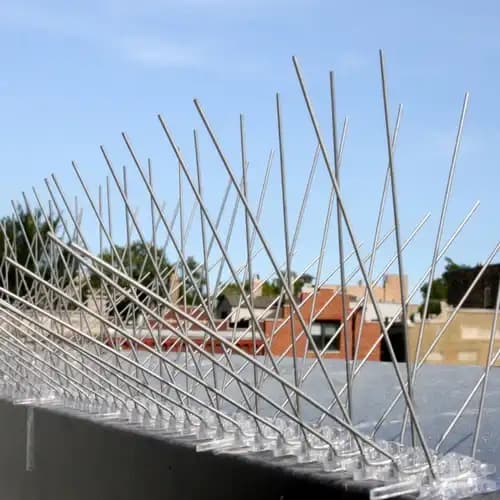
A clear base does not mean the entire spike is plastic, and a metal pin does not identify its grade. Ask for the supplied product rather than judging a catalogue photograph.
This common arrangement combines slender pins with a formed base. Confirm the pin and base specification, outdoor suitability and intended coverage. The attachment method should suit both the strip and the surface it is mounted on.
A metal base and pins may be proposed for some surfaces. Material grade, finish and compatible fasteners still matter. The word stainless does not promise that every component remains unchanged in every coastal exposure.
Product shapes and coverage differ. Ask about the actual outdoor specification and limitations before comparing a plastic strip with another design. Stock availability and the selected model should be clear in the written quotation.
The substrate matters
In Vizag, discuss the actual moisture and salt exposure at the perch. The durability of the attachment depends on the surface as well as the spike product.
Paint, stone, concrete, coated metal and a waterproofed edge need different consideration. Loose finishes or visible corrosion should be addressed before attachment. Drilling into a sensitive surface may require an agreed detail and property permission.
A suitable adhesive or mechanical attachment may be possible according to the strip and substrate. Confirm the method rather than accepting a universal no-drilling promise. Existing surface defects are not corrected simply by covering them with a new base strip.
The selected system may require cleaning, a prepared surface and suitable conditions while the fixing cures. Confirm those requirements and the separately agreed cleaning scope. A strip that appears fitted should not be disturbed before the fixing process is complete.
AC units, signs and service ledges
Treating the place birds land should not create a new obstruction for the people who use or maintain the building. Show the surrounding equipment during assessment.
Identify whether the perch is on the appliance or on a separate ledge. Respect the equipment’s instructions, airflow and servicing clearances. Netting the surrounding recess may be worth discussing if nesting occurs behind the unit.
Take a wide view that shows the surface, wiring access and adjoining perches. Curves and supports can interrupt a straight-strip layout. Agree how the treatment will be serviced when the sign or facade needs work.
Handrails, walkable edges and accessible sills may be unsuitable for spikes. Preserve required access and escape routes. A bird-control product should not be casually positioned where someone may use the surface as a handhold.
Compare completed work
The starting rate includes the selected strips, standard fixing and installation for the agreed scope. It is a length-based price, not a square-foot netting rate.
A wider ledge can need more strip length than a single row along the same ledge. Ask for total runs, the row layout and the treated width. These details make the final amount understandable before fitting begins.
A packet sold online may include only a specified length of product. A site installation also involves the agreed fixing and labour. Match the product, coverage and preparation before deciding which quotation offers the better fit.
Old-strip removal, extensive preparation, exceptional access or surface repair should be priced separately where required. Confirm minimum billing and tax treatment. Existing strip refitting is assessed as its own scope rather than charged automatically as a new installation.
Survey, placement and handover
A useful installation starts with the correct perch and ends with an understandable plan for future maintenance. Timing depends on the surface and access.
Send your Vizag area, floor level and safe photographs of the ledge. Include approximate length and usable depth, not only a close-up of birds. Mention any existing treatment and whether birds are nesting.
Confirm strip material, coverage, mounting method and the runs included. Resolve access and property permissions. Any cleaning, removal or surface repair beyond the standard fitting should be identified before the work date.
Once the surface and bird situation are suitable, complete the agreed preparation and fit the product according to its requirements. Pay attention to wall returns and interruptions so the layout does not leave an avoidable landing pocket.
Check the treated runs and explain any curing period or maintenance restriction. Keep the chosen product details and actual support terms. Ask whom to contact if a strip lifts or building work changes the perch.
Select and place appropriately
The intended purpose is to discourage landing on a suitable surface. Product choice, bird behaviour and the use of the ledge determine whether that treatment is appropriate.
Do not press strips into an active nest or seal an animal into an adjoining recess. Eggs, chicks or an injured bird may require the affected work to pause for appropriate local guidance. Explain the situation before scheduling.
Do not improvise a treatment using sharp construction offcuts. Use an identifiable bird-control product suited to the assessed perch. A location reachable by children, pets or routine maintenance staff needs its own placement decision.
Small birds or birds using a nesting cavity may bypass a perch treatment. Adding more of the same strip without reassessing the route can waste money. A net or another appropriate exclusion design may need discussion instead.
Repair and removal/refitting
We can assess loose strips and previous installations for repair or refitting. The question is why the treatment stopped covering its intended perch.
Inspect the surface condition and the compatibility of the old fixing. If the underlying paint is peeling, adding adhesive over the same finish may leave the cause unresolved. Reusable strips and necessary preparation should be identified in the repair quote.
Leaves or other material can create a landing pocket. The ledge may also be wider than the installed row covers. Arrange safe maintenance and review the coverage instead of reaching out to adjust an inaccessible strip yourself.
Plan removal and refitting with the work coordinator. Some strips may remain reusable while others need replacement. Check the surface and row layout again after the maintenance work is complete.

A focused bird-control decision
Choose the service that matches the surface and route. The same property can need separate treatments without treating every opening as the same job.
| Observed issue | Useful next step | What to avoid assuming |
|---|---|---|
| Pigeons perch on a suitable narrow ledge | Measure a spike layout | One front row always covers a wide surface. |
| Birds enter a balcony or AC recess | Discuss pigeon-net closure | A strip on a ledge closes the full opening. |
| Several species use common shafts | Discuss anti-bird netting | All bird species need the same mesh. |
| A family needs a safer open edge | Request a balcony or child-safety assessment | Bird spikes provide fall protection. |
Around Visakhapatnam
Share a safe view of the ledge with its approximate length and depth. Area links help arrange an enquiry; the perch and surface determine the treatment.
Mention whether people can reach the ledge and how windows or AC units are serviced.
For signs and commercial ledges, include building access and operating constraints.
Questions before booking
Bird spike installation starts from ₹120 per running foot including the selected strip, suitable standard fixing and installation. Ask whether the quoted quantity is ledge length or total installed strip length, and confirm the treated width and row layout.
A running foot measures length along a strip or ledge. The usable depth of a wide ledge may require multiple rows, so length alone does not describe complete coverage. A written quote should state the row count and its measurement basis.
Only if the selected product’s coverage and the usable ledge width make that layout suitable. A wide parapet can leave a landing pocket behind a single front row. Measure the depth, wall returns and obstacles before choosing the strip quantity.
Compare the actual pin material, base, outdoor specification, coverage and compatible fixing. Stainless pins can use a polymer base, while other designs are all-metal or moulded polymer. The label steel or plastic alone does not establish suitability for your ledge.
They can be assessed for a suitable perch using an appropriate product and fixing method. Report salt deposits, moisture and existing corrosion at the actual surface. Ask for the supplied material and mounting detail rather than an unqualified permanent rust-proof promise.
First identify whether birds land on the unit, its bracket or a separate wall ledge. The chosen placement must respect equipment instructions, fan and airflow clearance, servicing and access to covers. Do not assume drilling or gluing directly onto an appliance is acceptable.
A compatible adhesive may suit some strips and sound surfaces, while others need an appropriate mechanical attachment. Surface preparation, material compatibility and required curing conditions matter. Loose paint, a weak finish or a sensitive waterproof layer needs assessment before fixing.
Suitable bird-control spikes are intended to discourage landing rather than catch or injure birds. Product choice and placement matter, and no blanket harmlessness claim suits every installation. Smaller birds or established nesting spaces may need a different exclusion approach.
Spikes treat a suitable landing surface; they do not close the open face of a balcony. If pigeons enter a recess or nest behind an AC unit, measured pigeon netting may better address that route. Both treatments can be discussed for separate locations.
Such a location needs careful assessment and may be unsuitable. A handhold, walkable edge, escape route or a surface accessible to children and pets should not casually receive spikes. The treatment must fit how people use the building.
Report the nest before booking. Active nests, eggs or chicks may require the work to pause for appropriate local guidance. Spikes should not be pushed into an occupied nesting area, and some established nesting situations call for a different treatment after assessment.
Yes, we can assess loose strips or remove and refit suitable existing sections. Reuse depends on the strip, base and fixing surface. If paint is peeling or debris is bridging the pins, simply adding more adhesive may leave the original failure unresolved.
Inspect visually from a safe location for detached bases, debris and remaining landing pockets. Arrange attention after facade work, equipment servicing or visible damage. Do not reach outside or handle an inaccessible strip yourself.
Timing follows ledge access, preparation, product availability and any adhesive curing requirements. Confirm the appointment after the scope is agreed. Ask for the actual product and workmanship terms in writing rather than assuming a common warranty or service life for every strip.
Your Visakhapatnam team
Send your Visakhapatnam locality, floor level and safe photographs with approximate ledge length and depth. Mention nests, AC equipment and any old strips that need attention.