
Window ledges and shop signs
Explain entrance access, working times and any shared building permission.
Measure the perch in running feet
Ledge length is only the first measurement. Compare usable depth, strip spread, row count and the fixing surface to choose a neat treatment that remains practical to maintain.

Treat the ledge birds stand on with a strip layout that fits its full usable width. EverSafe offers bird spike installation in Eluru from ₹110 per running foot including the selected spikes, fittings and installation within the agreed scope.
Identify the landing surface
Photograph the observed perch and adjacent surfaces so the proposed layout covers the relevant landing space.
Note whether birds stand on a sill, parapet cap, AC bracket or projecting sign. Include the wall-side space behind the front edge. A deep ledge can remain usable if only its most visible edge is treated.
Explain whether the bird leaves the perch to enter a sheltered opening. Treating the ledge does not close that recess. A net or combined proposal can be considered when both a landing surface and an entry route are involved.
Length, depth and product spread
Record the ledge length in feet and its depth in millimetres or inches. Then compare that depth with the effective coverage of the proposed strip.
| Dimension | What to record | How it affects the plan |
|---|---|---|
| Ledge length | Each continuous run, including returns | The length that needs treatment. |
| Usable depth | The space from the front edge to the wall | Whether a single strip leaves a landing pocket. |
| Product size | Strip segment length, base width and pin spread | The supplied product's coverage and fitting layout. |
| Corners and interruptions | Steps, brackets and curved portions | Extra short pieces, rows or a revised treatment. |
| Installation access | Height and reachable work position | The method and extent of access work. |
A 100 mm-deep ledge and a 300 mm-deep ledge of equal length can need different row layouts.
Price, product and complete scope
From ₹110 per running foot including selected spikes, fittings and installation within the confirmed scope.
Work out a starting budget
Measure the total installed strip length across all required rows. A wide ledge may need more than one row.
Installation is included in the starting scope. The selected product, complete coverage, access and any agreed additional work determine the final quote.
The calculator uses total strip length across all rows. Confirm the row layout and any additional work in the quote. Repair and refitting are assessed separately.
Read the product description
Confirm the actual pin and base construction, dimensions and outdoor specification before comparing products.
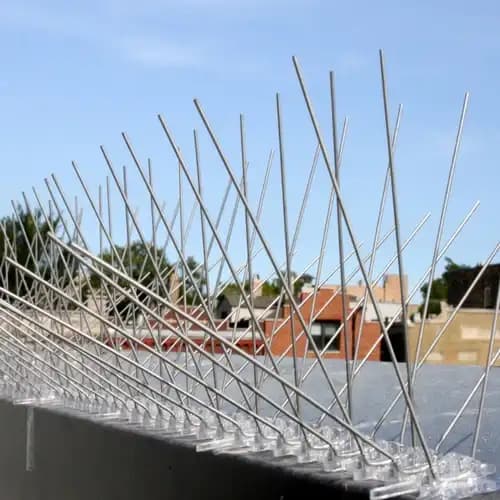
This arrangement can provide a discreet-looking strip, but the base still needs suitable outdoor properties and a compatible fixing. Check the pin material, segment length and effective coverage. A clear base does not make the whole strip invisible.
Other constructions may be available for assessment. Compare material, finish, coverage and attachment requirements for the actual perch. Product sizes vary: confirm the offered strip dimensions instead of assuming every pack contains equal coverage.
Prepare the surface
The strip can only stay in position if its fixing works with the underlying surface. Show damaged finishes and recent painting or waterproofing before the method is agreed.
Where the product and substrate allow it, a compatible adhesive needs the correct preparation and curing conditions. Dirt, loose paint or an unsuitable finish can undermine attachment. Agree how the surface will be prepared and when the strip can be left undisturbed.
Some surfaces need suitable screws, clamps or another compatible method. Sensitive stone, tile and waterproofed areas need a considered detail and property permission where relevant. Do not assume that either drilling or adhesive is suitable for every location.
Interrupted perches and services
A useful ledge layout continues around interruptions while preserving the building equipment and access people need. Send a wider view than the strip location alone.
Identify the exact landing surface and the space used during servicing. Respect equipment airflow, drainage, panel removal and manufacturer instructions. Avoid attaching a strip to a component that needs to move or obstructing a service technician's work position.
Show cables, bracket joints, opening shutters and shaped surfaces beside the perch. The selected product and attachment must suit these details. A broad flat sign top may need several rows, whereas a narrow curved support needs a different approach.
Understand running-foot billing
The starting installed price is ₹110 per running foot. Use the combined strip length across all required rows for the price illustration, then confirm the measured layout and complete scope in your quote.
Ten running feet of installed strips gives a starting example of ₹1,100. If a 10 ft ledge needs two continuous rows, it contains 20 ft of strips. Include every row and return when discussing the measured layout and final amount.
The selected spikes, fittings and installation are included in the confirmed scope. Surface preparation, difficult access, product changes and additional rows can affect the proposal. A scope-based refitting quote should identify reuse and replacement separately.
Eluru access planning
Send the locality, ledge photographs and available work position so access and surface preparation can be discussed.
For a shop sign or exterior window ledge, share the length, depth and access above the entrance. Explain when the premises can make the working area available and who can coordinate building permission.
For a home or workshop projection, show the actual landing space beside windows, exhausts or service lines. Note sensitive paint or waterproofing and any upcoming work that may require strips to be removed.
For an upper-floor sill or AC-related perch, state whether the work can be reached from inside the property. Include servicing clearance and nearby accessible surfaces so the layout can be reviewed as a whole.
From ledge survey to fitted rows
Timing follows the access, preparation and curing conditions needed for the selected fixing.
Identify the target bird, perch use, ledge dimensions and product. Report birds or occupied nests before work so the situation can be handled appropriately. Assess surfaces people or pets can reach before deciding on placement.
Complete agreed cleaning and surface preparation, then install the selected rows and return pieces with the compatible fixing. Exterior conditions must allow safe access and the required attachment process; weather can affect scheduling.
Check row continuity, corners and interruptions against the agreed layout. Confirm that windows, service equipment and drainage remain usable. Keep the product description and any curing or care instructions for future maintenance.
Use the right treatment
Spikes and netting solve different geometry problems. Match the product to the part of the building you need to address.
| Problem | Consider | Important distinction |
|---|---|---|
| Pigeons standing on a defined ledge | Suitable bird spikes | Treat the usable landing width and adjoining pockets. |
| Pigeons flying into a balcony | Pigeon safety net | Close the front and exposed returns. |
| Birds using ducts or multiple openings | Anti-bird net plan | Identify species, mesh and maintenance access. |
| A handrail used by people | Another suitable arrangement | Preserve the surface people need to hold. |
| A sheltered occupied nesting recess | Appropriate assessment before work | A simple perch strip may not suit the situation. |
Reuse where appropriate
Old spikes do not always need complete replacement. Send clear photos of the pins, base, old attachment and the ledge surface before requesting a repair price.
Existing strips can be assessed for careful removal and refitting where suitable. Agree which pieces can be reused and how the new surface will be prepared. Broken bases or distorted strips may need replacement.
Check whether a row lifted, debris created a landing pocket or birds moved to an untreated adjoining surface. Repairing attachment alone may leave incomplete coverage. Request a layout review when the pattern of perching has changed.
Eluru and nearby coverage
Share the exact address, ledge dimensions and photographs to discuss coverage and installation access.
Explain entrance access, working times and any shared building permission.
Show surface finishes, service lines and any planned painting.
Confirm the reachable work position and equipment servicing clearance.
Make an informed choice
The starting price is ₹110 per running foot including the selected spikes, fittings and installation. Our example uses the total installed strip length across all rows. The final quote confirms the treated width, row layout and any additional preparation or exterior access.
Ten running feet of installed strips gives a starting example of ₹1,100. A 10 ft ledge requiring two full rows uses 20 ft of strips. Measure all rows and confirm the complete installation scope before comparing quotes.
Both describe linear length in this pricing context. Neither is a square-foot area measurement. The website calculator uses the combined length of the installed spike rows; the written quotation should show the measured layout.
A deeper ledge can leave landing space behind a single front row. Its usable depth and the selected product's effective coverage determine whether more rows or another treatment are needed, even when the ledge length is unchanged.
The row layout follows the ledge depth, product spread and observed landing locations. Include gaps next to the wall and around brackets. There is no single row count suitable for every ledge or every spike product.
Compare the actual pin material, base construction, outdoor specification and attachment method. Some products combine metal pins with a polymer base. The material name alone does not establish the right coverage, grade of every component or useful life.
A compatible adhesive may suit a sound, properly prepared surface when the product guidance allows. Other surfaces need mechanical attachment or another detail. Confirm the substrate, finish and curing requirements before expecting a no-drill installation.
First identify whether the perch is the unit top, bracket or nearby ledge. Any treatment must respect equipment instructions, airflow, drainage and servicing. Netting may be more relevant if birds enter a recess behind the equipment.
A handrail is a surface people hold, so it may be unsuitable. Placement must consider ordinary use by adults, children and pets, along with cleaning and maintenance access. Assess a less accessible exterior perch or another treatment instead.
No. Spikes discourage landing on the treated perch; they do not close the open face, side return or duct behind it. Consider a measured pigeon or anti-bird net when the problem is entry into an opening.
Product suitability varies by bird and behaviour. Smaller birds may use spaces around some strips, while an occupied nest needs an appropriate response before work. A perch treatment should not be assumed suitable for an established nesting recess.
Yes, suitable strips can be assessed for refitting. Check the base, pins, old adhesive and new surface, and identify why any earlier fixing failed. Broken strips or unsuitable surfaces may require replacement or a revised attachment.
Timing depends on safe access and the selected fixing system's preparation and curing needs. Rain or a wet surface may prevent the intended attachment. The installer confirms workable conditions and any interval before the installation can be disturbed.
Check from a safe position for loose bases, bent strips, debris and new landing pockets. Review the layout after sign, paint or AC work. Request attention when coverage changes; do not reach outside or handle exposed pins unnecessarily.
Let’s plan your installation
Include a wide view, a close surface photo and your Eluru location. We can discuss product coverage, row count, installed measurement and refitting of previous strips.