
Town-centre building connections
For Main Road, Railway Station Road, RTC Complex Area and Kothapeta, show shared walls, upper-floor returns and who can authorise the proposed work.
- Main Road Tuni
- Railway Station Road Tuni
- RTC Complex Area
- Kothapeta
Tuni, Andhra Pradesh
Observed entry · a property-specific barrier plan
Start with where the animal actually arrives. A tree-side return, adjoining roof or reachable pipe can matter more than the open face you first noticed.
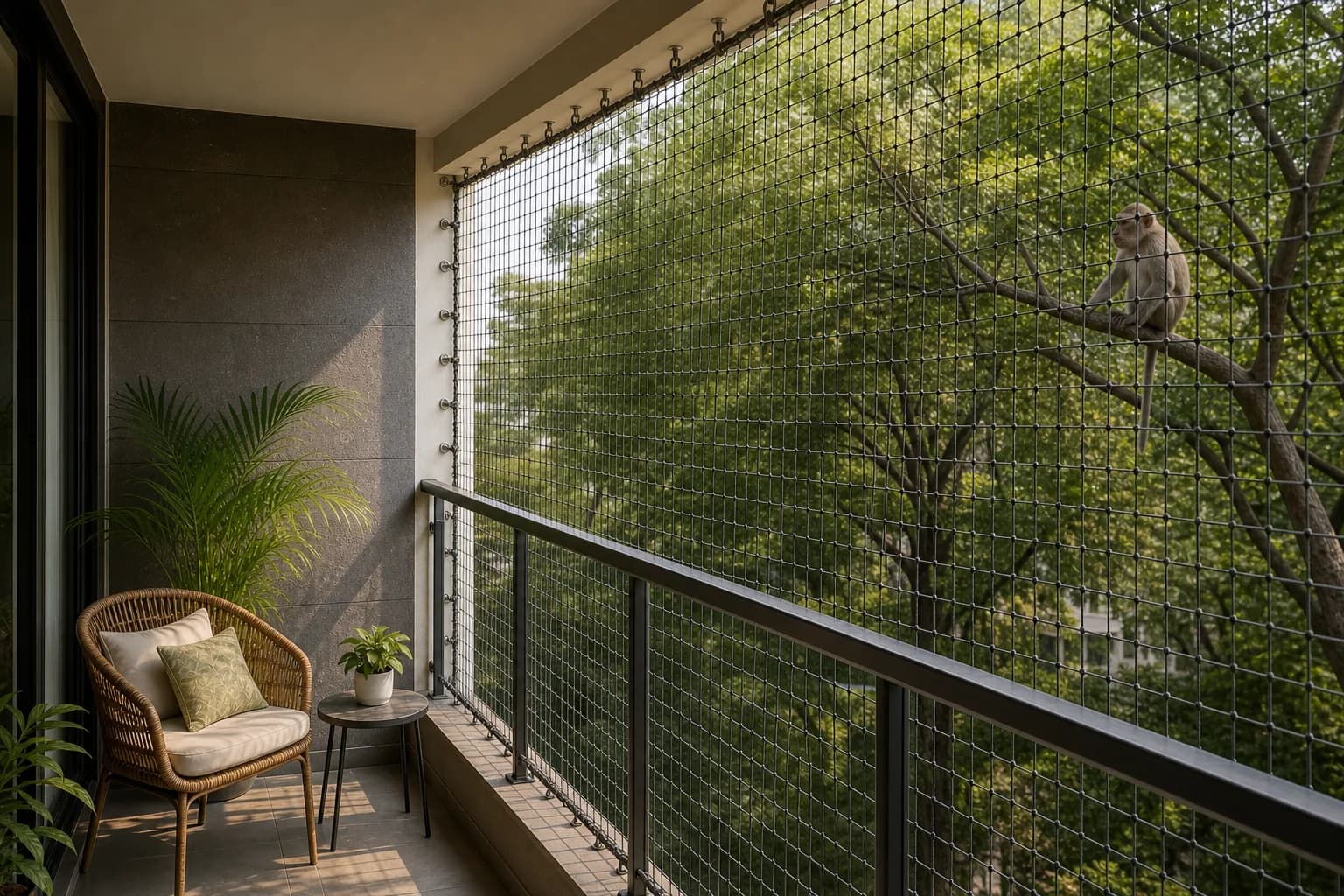
EverSafe assesses monkey safety net installations in Tuni from ₹35/sq ft including the agreed netting installation. We consider the observed route, intended barrier, supports and maintenance access. This service concerns property exclusion, not trapping, handling or relocation of animals.
Identify the route
Share the entry point and any safe photographs already available. Do not approach, provoke or feed an animal to obtain a picture; the survey can begin with a description and the empty opening.
For an Annavaram Road house, show any adjoining roof, pipe or branch near the affected opening. The address alone does not establish whether monkeys visit or which route they use.
At a Kothapeta or Main Road property, an animal may be reported on a side wall rather than the balcony front. Trace the observed route before deciding which face requires work.
Choose the barrier
Monkey exclusion can involve different demands from ordinary pigeon netting. Product choice and attachment design need to be considered together; a thicker-looking mesh is not proof of suitability.
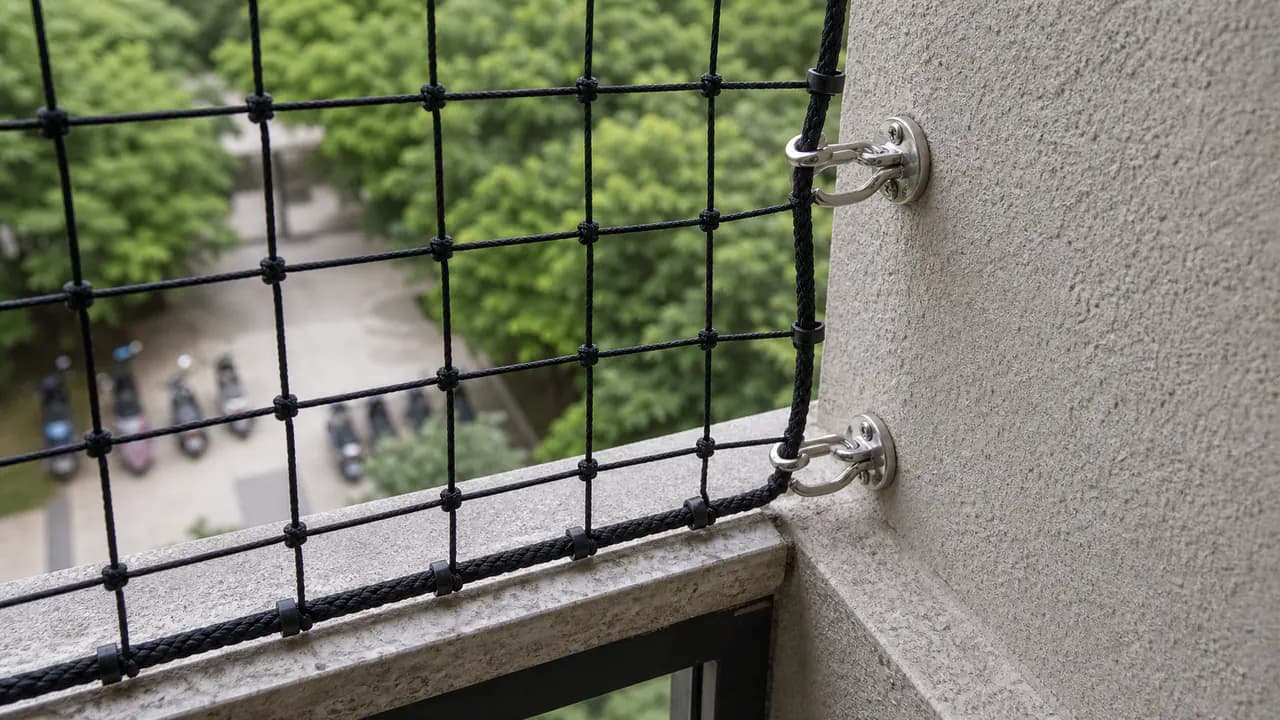
Discuss the intended barrier, twine construction, opening and border. Market material names or brand labels alone do not establish how an installed system will perform at your site.
If the proposed netting cannot appropriately address the observed route and supporting conditions, discuss alternatives with a qualified installer or relevant professional instead of promising universal protection.
A clear starting point
The starting netting rate is ₹35/sq ft including the agreed installation. A 100 sq ft panel starts at ₹3,500, subject to suitability of the product, boundary and supports.
Your space, your starting budget
Use the width and height of one net or grill face, rather than the balcony floor area. Add other faces to the final enquiry.
Installation is included in the starting scope. The selected product, complete coverage, access and any agreed additional work determine the final quote.
The starting netting figure does not establish that a particular opening is suitable or include animal handling. Repairs and any additional structural work are separately assessed.
Survey the boundary
The assessment reviews connected faces, top returns, corners and service sections. Exclusion should not leave animals trapped within an enclosed space or separate dependent young.
Photograph side returns and the space above the balcony from indoors or another safe position. An untreated adjoining face can leave the original route available.
Tell us if animals are present or returning to an occupied sheltered space. Appropriate guidance is needed before work proceeds; netting should not be used as an improvised trap.
Supporting structure
A boundary is only as appropriate as the surfaces and fittings that support it. Fragile roof edges, loose plaster and decorative trim should not be assumed suitable for the proposed system.
In an older Tuni home, show cracks, previous drill holes and weathered finishes near the planned border. The condition of the underlying support needs assessment.
An extended face or top enclosure may require additional support or a different arrangement. Confirm that scope separately rather than expecting the mesh alone to bridge every opening.
Plan the visit
The installation is arranged once the route, product, supports and access requirements are understood. Any animal presence or unresolved site concern can affect when work can proceed.
For a Railway Station Road building, establish permission for shared roof or wall areas. Plan the space below the work and any service route that must stay available.
At handover, inspect the perimeter and operation of any access section. The household should know how to secure openings and report damage without approaching animals outside.
Damage assessment
EverSafe assesses monkey-net repairs, panel replacement and reattachment in Tuni. A repeated damaged corner may indicate an unsuitable support or barrier arrangement rather than only a torn panel.
Send a clear empty-opening photograph and a close view of the damaged component. Retained netting must remain suitable for the intended exclusion purpose before patching is considered.
If activity moves to another face, explain that change. Extending a panel may need a fresh boundary assessment instead of adding mesh to the first available hook.
Compare the need
Choose the service that addresses the actual observed problem. A product installed for birds, sports or general terrace use should not automatically be reused for monkey exclusion.
| Your requirement | This service | Alternative to discuss |
|---|---|---|
| Observed monkey access to a building opening | Assess the route, suitable barrier and supports | A pigeon net may be inappropriate for the purpose |
| Pigeons nesting in an AC recess | Use a bird-specific exclusion plan | See pigeon net installation |
| People using an open terrace edge | Assess the boundary and existing guards for that use | See terrace safety guidance |
| An animal currently needs handling | Net installation does not provide capture or relocation | Seek appropriate local animal-response guidance |
After installation
Check the installation from a safe position and report loose edges, damaged mesh or shifted fittings. Do not test the barrier by hanging loads or encouraging animals to interact with it.
Keep food waste and other attractants managed as part of household routines. A barrier does not replace responsible waste handling or appropriate advice about recurring animal activity.
Roof repair, new pipes or tree-side changes can alter an entry route. Review the boundary after such changes before assuming the original arrangement still addresses the problem.
Prepare your request
A useful quotation enquiry states where entry was observed, the opening dimensions, floor and supporting surfaces. Photographs should be taken only when it is safe to do so.
For Payakaraopeta Road, Tuni New Colony or Market Yard locations, send the exact address pin and access details. Coverage does not imply that every nearby property has the same animal issue.
Ask the quote to name the selected barrier, netted faces, fittings, extra supports and access sections. No universal animal-proof, load or lifetime guarantee is claimed.
Tuni and nearby coverage
We use your reported activity and building details, not assumptions about a neighbourhood. Describe the route at the specific property and provide safe views of the surrounding boundary.
For Main Road, Railway Station Road, RTC Complex Area and Kothapeta, show shared walls, upper-floor returns and who can authorise the proposed work.
For Tuni New Colony, Payakaraopeta Road, Annavaram Road and Market Yard, show the affected roof or balcony face and any observed approach route.
Make an informed choice
Netting starts at ₹35/sq ft including the agreed installation, subject to a suitable barrier and site plan. Extra support work is separately specified.
No locality-wide claim is made. The assessment begins with activity reported at your specific property.
Do not assume it is suitable. Monkey exclusion requires consideration of the selected barrier and complete supporting arrangement.
No. This is a property-exclusion installation service, not animal capture, handling or relocation.
Tell us before scheduling closure. Do not trap them or dependent young; appropriate local guidance is needed before proceeding.
No. Use an existing safe photograph or a description. Do not approach, provoke or feed an animal to obtain survey material.
Yes, show the reported route, adjoining faces and supports from safe positions. The full boundary needs consideration.
Existing installations can be assessed for repairs or replacement. The retained material, supports and cause of failure guide that decision.
A suitable arrangement may be planned where needed, with a clear securing method and responsibility after use.
No. Material appearance alone does not establish a suitable system; supports, perimeter and the observed route matter as well.
Only if expressly listed. Additional frames or structural corrections must be stated in the final scope.
Send a route description, safe empty-opening photos, measurements, floor and exact pin. Note any current animal presence before a visit is arranged.
From your first photo to the final fitting
Share the empty opening and supporting edges safely. We can assess a suitable exclusion plan or review damaged existing netting at your Tuni property.