Other ways people ask
Around Vidyaranyapura, people do not always use one exact phrase. These are the fuller ways the request usually shows up when the household is comparing fit, finish, and installation details.
Local service page
Start with three facts: which bird is entering, which route it uses and how large the smallest gap is. That diagnosis determines whether a Vidyaranyapura opening needs standard pigeon mesh, tighter anti-bird mesh or a different ledge treatment.

Compare before deciding
This page stays focused on what usually changes around Vidyaranyapura. If you are still comparing material, price, safety fit, or nearby visit options, the Bangalore Pigeon Safety Nets guide gives the broader picture before you call. You can also browse the Bangalore area guide when you want to check nearby local pages.
City guide
Compare Pigeon Safety Nets materials, fitting choices, price factors, and visit planning across Bangalore.
This area
Use this page when the opening, building access, or daily routine around Vidyaranyapura is the main concern.
Nearby options
Move between the city guide and local pages when you want either a wider view or a closer match.
Area fit
A useful pigeon net nearby result should recognise the exact layout and ask which bird enters the opening. Vidyaranyapura includes several residential sub-layouts and connects with Doddabommasandra, Thindlu, MS Palya and other north Bangalore pockets, so the address and species should accompany the first photos.
Nearby landmarks
Vidyaranyapura apartment balconies, independent-home windows and utility openings
NTI Layout and BEL Layout pigeon, dove and smaller-bird entry assessments
AMS Layout and Nanjappa Layout balcony, grill and AC-gap enquiries
Defence Colony, Chamundeshwari Layout and Srinidhi Layout bird-control requests
Doddabommasandra and MS Palya-side terrace, window and utility openings
Thindlu-side homes where the target bird and smallest active gap need confirmation
Local wording
People looking for pigeon safety nets around Vidyaranyapura, Bangalore rarely describe it the exact same way every time. The wording usually shifts with the home, the routine, and the first problem that starts feeling noticeable.
Vidyaranyapura bird netting starts with the smallest target species, not the largest product claim.
EverSafe labels any unconfirmed species assumption instead of presenting a blurred photo as certainty.
This usually shows up around
Around Vidyaranyapura, people do not always use one exact phrase. These are the fuller ways the request usually shows up when the household is comparing fit, finish, and installation details.
Target bird and actual building entry confirmed before mesh selection
Pigeon-sized and tighter smaller-bird openings compared as different requirements
Balconies, grills, windows, AC ledges, vents and utilities classified by route
Transparent, coloured, flexible and rigid options explained without vague quality labels
This guidance works best when it answers the practical concerns people carry into the call, not just the first words they use.
identify whether pigeons or smaller birds are entering the building
understand why one pigeon mesh does not suit every bird species
choose mesh opening without making the balcony denser than necessary
distinguish a landing ledge from an open-volume entry problem
Pigeons commonly use broad ledges, parapets, AC shelves and sheltered balcony corners. Smaller birds may pass through narrower grill gaps, pipe returns, ventilators or utility openings. If both are present, one opening may need a different mesh from another even within the same home.
The first question is not which colour looks right. It is whether birds are merely passing outside, landing on one exposed strip, or crossing into a usable building space. Netting is most relevant for a defined opening or entry volume; one narrow perch may suit spikes, while a small framed vent may suit rigid mesh.
A species-aware estimate records the target bird, proposed mesh opening, strand or material description, complete perimeter, access needs and areas deliberately left untreated. This prevents a pigeon-sized product from being sold as a universal anti-bird net and avoids unnecessary dense mesh where the problem is only a larger pigeon route.
EverSafe accepts enquiries from Vidyaranyapura, NTI Layout, BEL Layout, AMS Layout, Nanjappa Layout, Defence Colony, Doddabommasandra, Thindlu and MS Palya-side properties. Availability, exact scope and final pricing remain address- and site-dependent.
Service visual guide
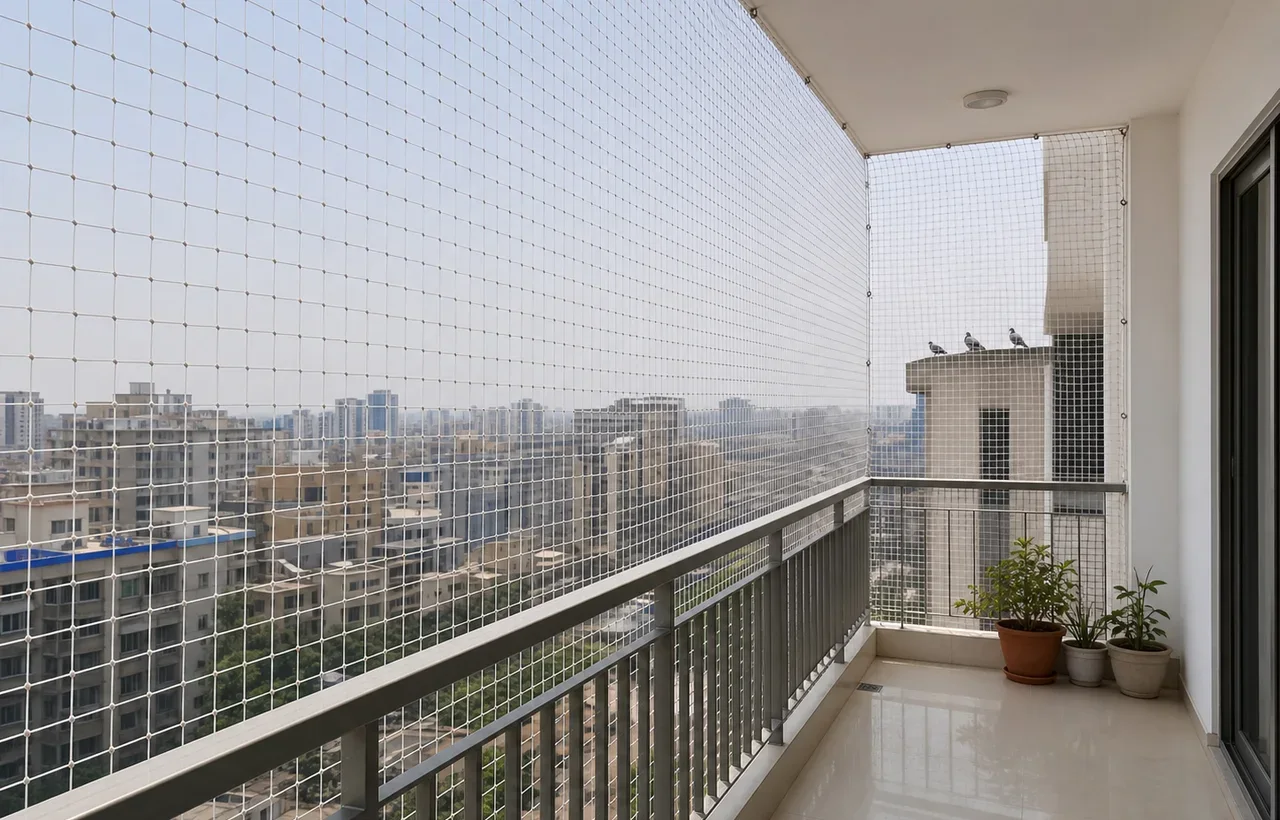
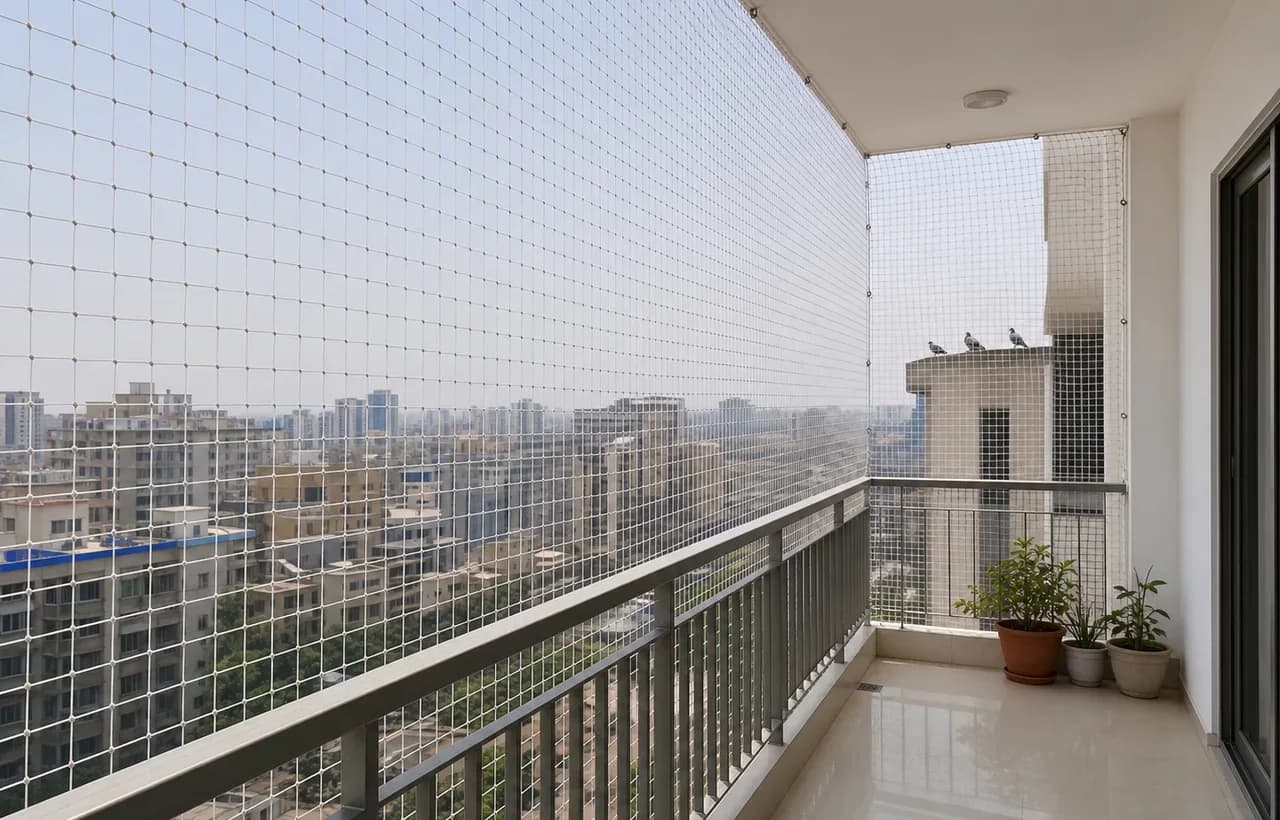
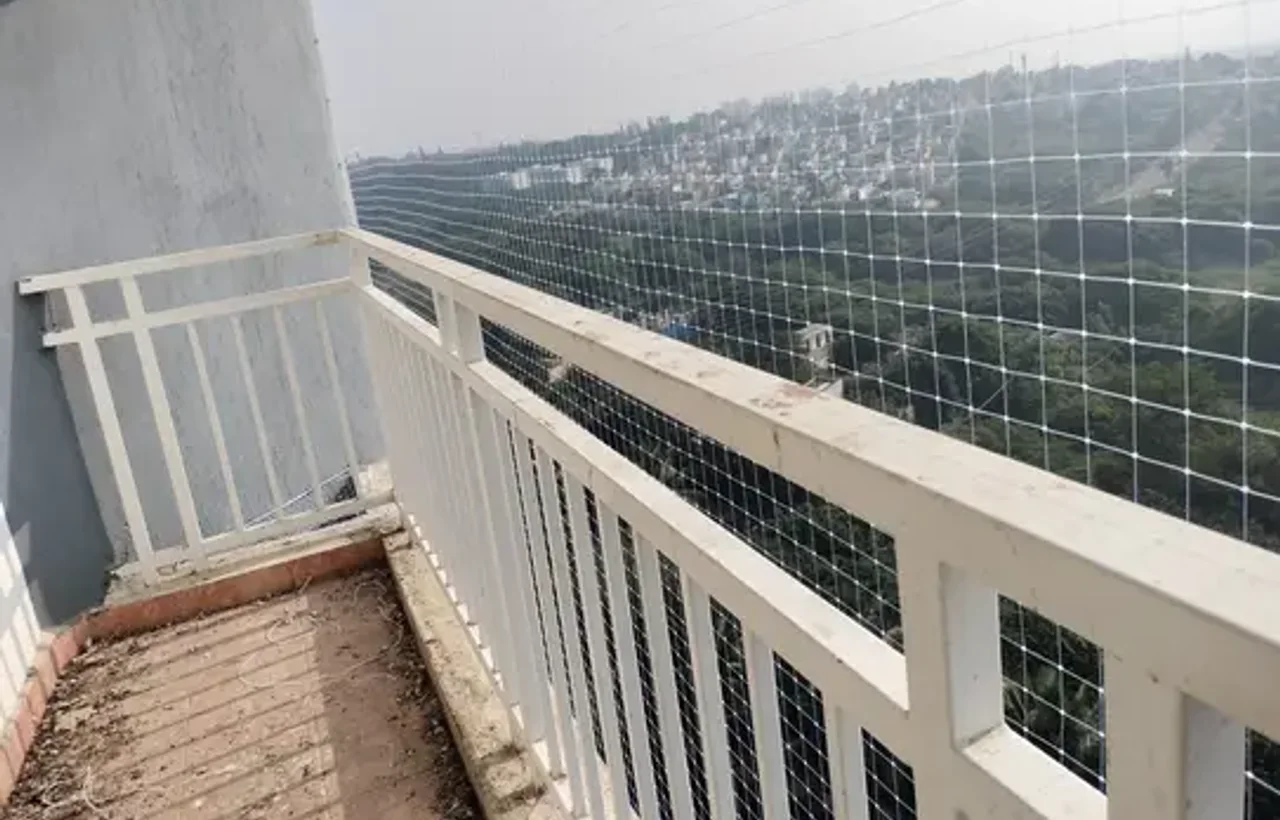
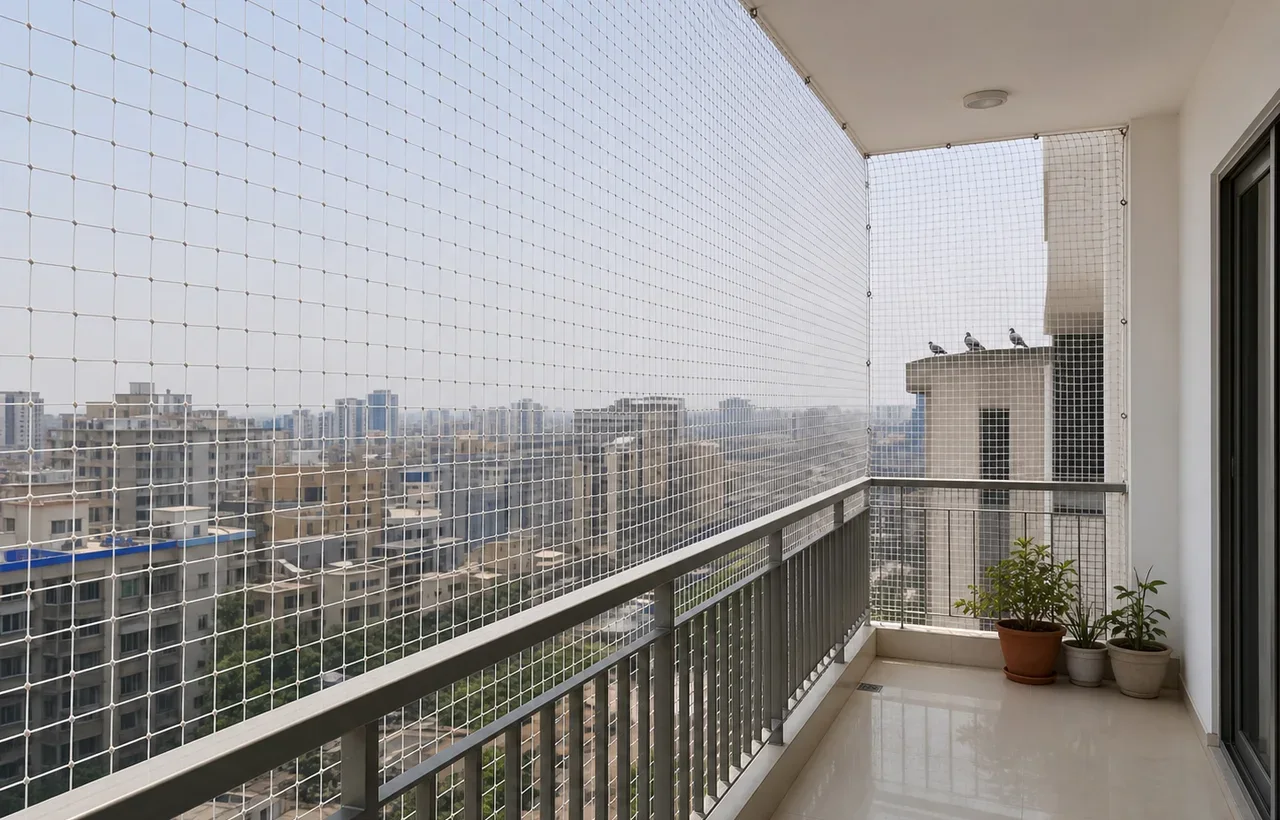
These representative images support the written guidance below; the exact opening still needs its own measurement and access check.

Representative opening view
Use this reference when sharing the opening span and return corners.

Installation planning view
The exact edge condition and anchor position are confirmed on site.

Fit and access reference
Final appearance depends on the measured opening and everyday access needs.
Local fit
A resident may ask for pigeon netting after seeing birds near a balcony, yet the actual issue can be one pigeon perch, a smaller bird entering through a grill, or several species using different parts of the property. Choosing material before identifying the route can leave the smallest gap unresolved or make the opening unnecessarily dense.
Observe the bird and behaviour, measure the narrowest active gap, and classify every zone as entry volume, landing strip or framed aperture. Then match mesh opening, material, visibility and perimeter to that zone while keeping windows, drainage, airflow and equipment access usable.
A dependable proposal names what it knows and what still needs site confirmation. EverSafe does not invent a Vidyaranyapura result, claim that one mesh blocks every species, call transparent net invisible, or publish unverified ratings, brands, warranty periods and product-life promises.
Nearby Colony-Family Context
these nearby locality and local cues help reflect the low-rise family pattern around Vidyaranyapura, where pets, plants and long-settled household routine can make the balcony feel too ordinary to question properly.
Primary location for species-aware balcony, window, AC and utility bird-net enquiries.
Adds precise context for apartment and independent-home pigeon or smaller-bird routes.
Supports balcony, grill, AC shelf and utility-opening what people usually ask for.
Useful for hyperlocal pigeon-net, window-mesh and mixed-bird enquiries.
Connects local grill-gap, balcony and transparent-net requests to a recognised layout.
Provides a specific local cue for window, vent and home-balcony assessments.
Supports nearby terrace, apartment and independent-house bird-net searches.
Adds local context for homes between Thindlu and Vidyaranyapura using either address label.
Useful for north-west-side balcony, utility and rental-property enquiries.
Helps distinguish building-entry treatment from unrelated birds moving through surrounding green areas.
Decision Pattern
Resident seeing pigeons on one ledge
A pigeon sitting on a parapet may need a ledge solution, while a pigeon walking behind the railing creates an open-volume exclusion problem. Observation prevents the proposal from covering more—or less—than the active route.
Home with smaller birds entering
When a smaller bird crosses the opening, standard pigeon mesh may be too open. The survey should identify the entry gap and explain the visibility and cleaning trade-off of a tighter product.
Property with mixed bird routes
The balcony may need pigeon exclusion while a kitchen vent needs a smaller rigid or flexible mesh. Each opening can be itemised with its own aperture, perimeter and service clearance.
customer comparing net products
The customer should align material, opening, strand construction, exterior suitability, perimeter, safe access and total. Transparent, white, green and branded claims become meaningful only after those facts match.
Price-focused local searcher
Marketplace figures can indicate a range, but the final Vidyaranyapura total also depends on minimum billing, number of zones, finer mesh, hardware, access, removal, taxes and service terms.
First diagnostic
Bird / route / gap
These three facts guide aperture selection before colour, brand or price.
Indicative listing band
₹16–₹25/sq ft
Example Bengaluru marketplace figures with differing products and scopes, not a fixed local rate.
Key product split
Pigeon / smaller bird
A tighter opening is justified by the smallest target species, not by a well-finished label.
Building mix: Composite residential locality with apartments, independent houses and named layouts where balcony, grill, window, terrace and utility openings may attract different bird-control enquiries.
Outdoor conditions: Dust can be more visible on fine or dark-background mesh, while exposed edges need periodic checks after strong weather. Mesh density and inspectability should be discussed instead of promising a maintenance-free product.
Common layout cue: For Vidyaranyapura, estimate photos should show the bird at or near the route when possible, a scale reference for the smallest gap, and a wide view connecting the grill, parapet, AC unit, window or utility opening.
An NTI Layout balcony where pigeons land on a broad slab but do not cross the railing line
A BEL Layout utility grill where a smaller bird enters through one pipe-side opening
An AMS Layout apartment with pigeons on the AC shelf and small birds near a separate exhaust gap
A Nanjappa Layout home comparing transparent pigeon mesh with tighter anti-bird net
A Defence Colony window requiring shutter clearance and a small framed-mesh section
A Doddabommasandra terrace with an open parapet and one sheltered stairhead route
Diagnostic content organised around target species, behaviour, gap and building route
Pigeon netting and smaller-bird netting treated as related but non-identical scopes
Material, mesh opening and edge system requested in writing before product comparison
Local price guidance tied to visible marketplace examples rather than a made-up fixed rate
Humane closure and non-target wildlife considerations kept inside the service process
No fabricated Vidyaranyapura installation count, customer story, rating or outcome percentage
The correct method follows the target bird and the shape of the route. A broad balcony, narrow grill gap and parapet strip are three different physical problems even when the homeowner describes all of them as pigeons near the house.
Works well for: Balconies, utilities and open bays where pigeons are the confirmed target species
A suitable pigeon-oriented opening can keep the barrier visually lighter while closing the complete volume. It may not stop a much smaller bird, so species confirmation matters.
Works well for: Window grills, utilities or balcony zones used by smaller birds as well as pigeons
A reduced opening can exclude the smaller target, but the mesh can appear denser and gather more surface dust. Use it where the observed route justifies the trade-off.
Works well for: View-facing balconies where a less prominent appearance is important and the opening suits the target bird
Fine clear strands can attract less attention at normal distance, yet sunlight, dust and contrast still reveal them. Transparent describes appearance, not invisibility or universal bird coverage.
Works well for: A compact ventilator, exhaust surround or defined grill-frame aperture
A rigid panel retains shape inside a small frame and can use a tight opening. It looks heavier and is not a practical substitute for flexible mesh across a wide balcony.
Works well for: One narrow parapet, beam or AC-side strip used only as a landing surface
Spikes discourage landing on the treated strip but do not close an entry volume or small gap. Nearby ledges must be checked so birds do not move a few centimetres away.
Works well for: Properties where feeding, exposed grain, pet food or sheltered loose material encourages repeated visits
Removing attraction can reduce repeat visits, but it does not close an established building entry. Use it alongside the physical solution when both conditions exist.
Works well for: A small, simple aperture that is fully reachable from a protected interior position
Online material still requires the correct opening, exterior-suitable specification, anchors and continuous perimeter. Never reach beyond a balcony or roof edge to fit a cheaper kit.
Ask for clear photos or short observations of size, shape, behaviour and time of use. A distant or blurred image may support a preliminary view but should not force a confident species label.
Record whether birds only fly nearby, settle on one outer strip, or cross behind a grill, window, parapet or utility boundary.
Check grill spacing, pipe returns, ventilators, chajjas and equipment gaps with a scale reference. The narrowest route used by the target bird guides the opening requirement.
Follow the route across the balcony face, top band, side returns, AC shelf, window, drain and utility corner so the selected mesh does not end before the entry does.
Compare standard pigeon mesh, tighter flexible net, transparent strands and rigid panels according to species, exposure, visibility and frame geometry.
Confirm window travel, exhaust airflow, drainage, clothes drying, AC servicing, grill access and cleaning before the perimeter is fixed.
Show dimensions, rate, minimum, mesh opening, material, hardware, access, removals, taxes and exclusions. Mark any detail that remains subject to site confirmation.
Do not secure the final return until the zone is clear. When an adult bird, egg, chick or active nest may be present, pause and determine a suitable humane next step.
Show the completed edges, identify any untreated perch, explain inspection after maintenance, and advise the household not to leave food where it encourages return visits.
A pigeon regularly sitting on a wide parapet and a smaller bird passing through a grill are separate problems; the estimate should not merge them under one one-size-fits-all bird-net label.
Greener surroundings can bring birds close to a property without proving that they enter the home. Net only the defined building route that needs exclusion.
A smaller-opening mesh can look denser and catch more surface dust, so it should be selected because the target species requires it, not simply because it sounds stronger.
Window grills, exhaust cut-outs, pipe gaps and utility vents should be measured at their narrowest active point when smaller birds are involved.
Open parapets and AC shelves used by pigeons may suit a larger-volume net boundary or a ledge treatment, depending on whether birds land outside or enter behind the edge.
Residents should mention feeding near the property because removing an accessible food source can be part of reducing repeat visits even when physical exclusion is still needed.
The proposal records the reported bird, observed behaviour and smallest relevant gap before recommending mesh opening.
Different openings can receive separate product lines when pigeon and smaller-bird routes do not match.
Price examples state whether they refer to marketplace material, installation or a complete measured scope.
Transparent and coloured products are compared by specification and visual effect, not treated as automatic durability grades.
Review and aggregate-rating markup remains disabled until evidence for this exact service page exists.
The wrong mesh can look complete while a smaller bird still passes through the same utility gap.
An unnecessarily dense net can reduce the visual openness of a balcony without solving a different perch outside it.
A single unmeasured pipe return can keep an established entry route active after the main face is fitted.
A low material price can become a poor comparison when anchors, perimeter, access and installation are excluded.
Final closure without a bird-and-nest check can trap the very animal the net is meant to exclude humanely.
ordering pigeon-sized mesh when a smaller bird is using the narrowest gap
installing tight small-bird mesh when only one broad pigeon perch needs treatment
assuming every bird seen in nearby trees is entering or nesting in the property
covering the balcony face while leaving a grill, ventilator or pipe return active
choosing material from colour, the word nylon or a well-finished label alone
comparing rates without checking mesh opening, perimeter and installation inclusions
Starting from For rough planning, some current Bengaluru marketplace listings show pigeon-net product or installation examples from about ₹16 to ₹25 per sq ft. The scopes differ, so this is not a fixed Vidyaranyapura installed rate. Tighter mesh, small-job minimums, several zones, frames, access and removal can move the final total outside the band.
measured area of each balcony, window, grill, vent or utility plane
pigeon-oriented opening versus tighter smaller-bird mesh
flexible standard, transparent monofilament or rigid-panel construction
number of separate zones, pipe gaps, returns and framed apertures
linear perimeter, anchor surface and supporting hardware
minimum completed-job charge for a very small window or vent
floor level, safe working reach and obstacles around the opening
old net, temporary wire, spike or failed-anchor removal
Pigeon safety net is a familiar service name, but it does not answer every bird-entry question. A material suitable for a broad pigeon route may leave an opening that a smaller bird can cross. Conversely, a very tight mesh can add visual density where it is not needed.
Start with an observation, not a guess. Record where the bird lands, whether it crosses the building line, and which opening it uses. A clear diagnosis reduces both under-specification and unnecessary material.
Vidyaranyapura locality references describe extensive greenery and more than one bird species. That context makes careful scoping important: birds flying between trees or resting outside the property do not automatically justify enclosing a balcony or treating vegetation.
Building-focused exclusion should target a repeated perch, nest site or entry route that affects the usable space. The estimate can explicitly leave unrelated greenery and passing wildlife outside its scope.
Mesh opening is the central difference. A pigeon-oriented barrier can be visually lighter, while a smaller target may require a tighter aperture. The estimate should state the supplied opening rather than merely calling one option standard and another well-finished.
If two species use separate places, zone the products. The main balcony can receive pigeon mesh while a narrow ventilator or utility grill receives tighter flexible or rigid material. One universal roll is not automatically the most economical completed solution.
Balcony plants do not by themselves prove the need for netting, but pots, shelves and stored material can create sheltered corners. Exposed grain, pet food or intentional feeding can also encourage return visits even after cleaning.
Keep the balcony free of accessible food and loose nesting material, then close the confirmed building route where physical exclusion is needed. Do not place mesh directly against plant growth or moving items that can rub the strands.
A window problem may be controlled by grill spacing, the chajja above, an exhaust cut-out or a pipe beside the frame. Photograph the full window and place a safe scale reference near the active gap so mesh choice is not based on visual guesswork.
Sliding, casement and outward-opening windows need different clearances. A fixed or removable framed section can be considered where regular cleaning or equipment access matters, but its boundary must remain continuous when closed.
Pigeons often use the broad outdoor-unit shelf, while a smaller bird may pass beside the refrigerant pipe or drain. These are physically different routes. Show the whole equipment recess rather than requesting a net from one close-up of droppings.
The finished plan must retain airflow and future technician access. Agree whether service uses a designed section or a professional opening and refit; an informal cut can defeat the selected aperture and perimeter.
Utility openings combine pipes, grills, drains, shelves and quiet corners. They are common places for a large bird to land and a smaller bird to enter through a different route. Itemising those routes makes the material decision easier to audit.
Apartment ducts may also involve common-property boundaries or access from another level. Confirm who can authorise the work and whether the estimate protects one private opening or a shared vertical zone.
A pigeon that only sits on one parapet cap may not require a full terrace enclosure. Spikes or another ledge-specific method can be compared if the treated strip is the complete landing point and nearby surfaces will not simply become substitutes.
When birds move behind a parapet into a stairhead or covered terrace bay, the issue becomes an open-volume route. Map the top and side returns and preserve drainage, tank and maintenance access before recommending flexible mesh.
Transparent pigeon net can make a view-facing opening feel visually lighter, but the strands remain visible in reflection, dust, close views and contrasting light. The phrase invisible pigeon net should be treated as a search term, not a literal performance promise.
White pigeon net, pigeon net green and darker colours can blend differently with grills, walls, sky and foliage. Colour does not establish mesh opening, polymer, outdoor suitability or service life, so compare the underlying specification first.
Nylon anti-bird net is frequently used online as a broad category, though a supplied product may instead be HDPE, polypropylene, copolymer or monofilament. Request the exact material description and aperture rather than treating nylon as a synonym for every flexible net.
Pigeon wire mesh is a rigid product category and can suit a small frame. Flexible netting is generally more adaptable across an irregular balcony volume. Neither material is automatically right without the bird, opening and access context.
At the indicative marketplace band only, 80 sq ft calculates to ₹1,280–₹2,000, 140 sq ft to ₹2,240–₹3,500 and 240 sq ft to ₹3,840–₹6,000. These figures are arithmetic illustrations, not quotations and not proof that every installation or mesh type sits in the range.
A tight small-bird product, rigid frame, several tiny openings, removal, access or minimum billing can change the total. Marketplace material prices and completed installed prices should never be combined without checking inclusions.
Place competing estimates into matching columns: target bird, mesh opening, material, strand or construction, dimensions, perimeter, included gaps, access, removal, tax, warranty wording and total. A cheaper estimate may simply describe a larger aperture or fewer returns.
Where the species is not yet clear, ask the provider to label the assumption. A conditional recommendation is more credible than pretending a distant photo proves every detail.
Spikes suit an isolated landing strip; rigid mesh suits a compact framed hole. Flexible netting suits an open volume. Choosing among them is a geometry decision as much as a material decision.
A mixed Vidyaranyapura property can use all three in different zones. Each line item should explain why it matches that zone and how it connects to adjacent returns.
Online listings may describe agricultural, sports, packaging or general safety netting alongside balcony bird mesh. Check intended use, aperture, roll dimensions, material, edge components and return terms before comparing the displayed price.
DIY remains limited to a small opening reachable entirely from a secure interior position. Never lean beyond a grill, parapet or window, and do not improvise anchors in an unknown exterior surface.
Garware pigeon net price is a manufacturer-led query. If Garware or another maker is quoted, ask for the exact product and reasonable packaging or invoice evidence; current availability must be confirmed at purchase time.
HiCare pigeon net is a provider-led query, not a standard aperture or polymer. Compare any provider through the same bird diagnosis, specification, perimeter, access, exclusions and completed total.
Avoid leaving grain, pet food or other accessible feed near the treated opening. Physical exclusion can close the building route, while food-source control reduces an avoidable reason for repeated visits. Neither step justifies harming birds.
Before the last edge is closed, check for an adult bird, active nest, egg or chick. If any may remain, pause and determine an appropriate humane and lawful response before completing the barrier.
Inspect the perimeter after AC service, window work, painting or severe weather. Fine mesh may show dust sooner, while any product can be damaged by sharp rubbing, informal cuts or a loosened edge. Clean only by a method suitable for the supplied material and safe reach.
One isolated cut may be repairable when the remaining product and anchors are sound. Widespread brittleness, several open returns, sag or the wrong aperture for the target bird calls for a replacement assessment.
Pigeon safety net and bird safety net are common names, but they do not demonstrate a rated child, adult or pet load. A mesh selected to exclude a bird should not be represented as a fall-arrest system without separate design and verification.
When the household needs both outcomes, request a dedicated balcony safety-net or invisible-grill assessment as a separate scope. Its anchors, spacing, documentation and testing requirements may differ.
Send the exact layout or nearby pocket, owner or tenant status, floor, approximate dimensions and one wide opening photo. Add a clear bird photo if safely possible, a short note on whether it lands or enters, and close-ups with scale for grills, pipes, AC gaps, windows and vents.
These are the practical questions households usually ask before choosing pigeon safety nets in Vidyaranyapura, Bangalore.
EverSafe accepts enquiries from Vidyaranyapura, NTI Layout, BEL Layout, AMS Layout, Nanjappa Layout, Defence Colony, Doddabommasandra, Thindlu and MS Palya-side properties. Exact visit timing depends on the address, opening, access and current schedule.
For initial planning, some current Bengaluru marketplace listings show pigeon-net product or installation examples around ₹16–₹25 per sq ft. Their scopes differ, so this is not a fixed EverSafe rate. Mesh opening, material, minimum billing, separate zones, frames, access, removal, tax and service terms affect the final estimate.
At ₹16–₹25 per sq ft, 80 sq ft calculates to ₹1,280–₹2,000, 140 sq ft to ₹2,240–₹3,500 and 240 sq ft to ₹3,840–₹6,000. These are arithmetic examples, not quotations. Small-job minimums and tighter or custom products can place the total outside the band.
Observe which bird actually crosses the building boundary and measure the smallest active gap with a safe scale reference. A pigeon-only route may suit a larger opening, while a smaller target requires tighter mesh. Do not select from the product name alone.
A clear close photo and a short note on size and behaviour may support preliminary guidance. A distant or blurred image may not justify a confident identification. The proposal should label any species assumption and confirm the route or aperture on site when necessary.
Yes. A broad balcony can use pigeon-oriented flexible mesh while a ventilator or utility grill uses tighter flexible or rigid material. Each zone should state its target bird, opening, perimeter and access method.
Around Vidyaranyapura, bird problems are often only one part of the decision. People also compare child safety, balcony-edge coverage and how to keep the front usable without making it feel closed in.
Useful when birds are only landing on narrow ledges, AC tops, beams, pipes or sign edges rather than entering a larger opening.
Open local pageUseful when the issue is broader bird control across openings, shafts or utility-facing areas, not just one balcony front.
Open local pageUseful when the issue around Vidyaranyapura is more about this specific service need than the original page you started from.
Open local pageUseful when drying clothes is what keeps daily movement happening close to the balcony edge in the first place.
Open local page